
Kameelah Janan Rasheed is a learner from East Palo Alto, CA


[A]: Rasheed, Kameelah Janan (2021)

I mean learning as a process of radical slowing down/deceleration in the context of almost compulsory acceleration under the current conditions; an attentiveness to a velocity that allows for a patient and close reading; an engagement with curiosity, serendipity, improvisation, and tangents. Learning is a persistent reminder of the shifting ecologies of what it means to know something.

︎


[B]: 
International End of Life Doula Association. “What Is an End-of-Life Doula?” last modified 2023? (accessed November 15, 2025). https://inelda.org/about-doulas/what-is-a-doula/


︎


[C1]: “Semitic Root,” Wikipedia, last modified November 14, 2025, https://en.wikipedia.org/wiki/Semitic_root


︎

[C2]: “Project Root List,” StudyQuran, accessed November 16, 2025, https://studyquran.org/PRL/PRLonline.htm


︎

[C3]: Wehr, Hans. A Dictionary of Modern Written Arabic: Arabic-English. 4th rev. ed. Edited by J. Milton Cowan. Ithaca, NY: Spoken Language Services, Inc., 1976.


︎

[D1]: Lispector, Clarice. Água Viva. United States: New Directions, 2012.


[D2]: Acheampong, Michelle, “Kameelah Janan Rasheed on Learning and Unlearning,” Art in America, July 1, 2021.

[D3]: Syllables of Velvet” and “Sentences of Plush” in Emily Elizabeth Dickinson’s 1862 letter to Eudocia C. Flynt.


[D4]: Rasheed, Kameelah Janan (2023)
︎

[E1]:  Hartman, Saidiya. Wayward Lives, Beautiful Experiments: Intimate Histories of Riotous Black Girls, Troublesome Women, and Queer Radicals. United States: W. W. Norton, 2019.; Emily Elizabeth Dickinson’s Letters (The Atlantic, 1862, L271 and L265)


︎


[E2]: Rasheed, Kameelah Janan (2023; 2021)


︎

︎

[F]: 
Lispector, Clarice. Água Viva. United States: New Directions, 2012.


︎

[G]: Emily Elizabeth Dickinson’s Letters (The Atlantic, 1862, L271 and L265)


︎

[H]: Renee Gladman and Fred Moten: One Long Black Sentence. United States: Image Text Ithaca, 2020.


︎

[I]: Imamura, “Escape Velocity,” last modified (n.d.), University of Oregon, accessed November 15, 2025,
https://pages.uoregon.edu/imamura/121/lecture-4/escape.html

︎


[J]:  Groom, Amelia. Beverly Buchanan: Marsh Ruins. United Kingdom: MIT Press, 2021.


︎

[K]: Rasheed, Kameelah Janan (2020)

︎

[L]: Gladman, Renee. Calamities. United States: Wave Books, 2020.

While texting with a friend (writer Zoe Hopkins) and interlocutor for another project, I mentioned that the compositional field of Google Docs felt restrictive. I wanted to swell beyond the compositional field of the word processor, as I wanted to exceed the page, so I went to the walls. Across three frantic messages, I shared 


In this meandering, she asked if I’d heard of Renee Gladman’s “commotional field” in Calamities (2016). I had not. To be honest, I felt betrayed, not from this friend, but of myself. I’d purchased Calamities years ago, and in working my way through a stack of books, I had not reached the shore of this text. I grabbed the book off my “need to read” shelf and began to read frantically. The commotion is riotous and disobedient. The compositional field refuses to settle. A compositional field speaks to the environment in which the writing occurs. Gladman’s articulation is almost an exponential expansion – that the compositional field has energy and affordances.


︎

[M]: Steyerl, Hito. “A Sea of Data: Apophenia and Pattern (Mis-)Recognition.” E-Flux, April 2016. 


︎

[N]:


︎


[0]: Glissant, Édouard. Poetics of Relation. Translated by Betsy Wing. Ann Arbor: University of Michigan Press, 1997

︎

[P]: “Multisensory integration — Neuroscience.” ScienceDirect. Accessed December 1, 2025. https://www.sciencedirect.com/topics/neuroscience/multisensory-integration.


Work Statement: slow and sprawling,

[wet]


How to Cite this Page: Rasheed, Kameelah Janan. “Work Statement: slow and sprawling,: [what is writing?].” KJR Studios Website. Accessed Month Day, Year. https://kameelahr.com/Work-Statement-sprawling


(Amended) notes from SFSIA Presentation on Wet Conceptualism (6 September 2025)
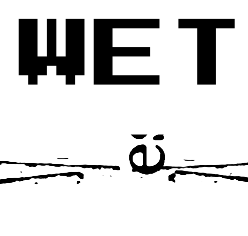
What is wetness?
+ Several years ago, a student told me that human skin lacks a single receptor dedicated to sensing wetness, unlike cockroaches and spiders

+ Wetness is not an intrinsic physical property; it is our interpretation of
a set of liquid/surface relationships as well as the interaction between multiple sensory signals

+ Because wetness is not direct sensory perception for humans, we interpret multiple sensory cues (temperature, pressure, and texture) to experience the sensation of wetness

+ Wetness relies on multisensory integration, or the nervous system’s combination of information from different senses to build a unified understanding of the environment

+ In neuroscience, this is called synthetic perception, or a perception that isn’t detected by a single type of receptor, but instead constructed in the brain from multiple sensory experiences.

What might wetness ask of us?
+ How might we describe an ethos of wettability, or our desire to bring our body in full contact with shifting systems and ideas?

+ If I seek to make wet work, maybe I desire to spill or leak onto the viewer; perhaps I want them to spill onto me?

+ If I am a wettable person, perhaps that means:

  • I welcome opportunities to draw closer to uncertainty, so that I develop a higher threshold for perpetual moisture

  • I seek to experience the world through many sensory modalities, cognitive states (mystical, synesthesia), metaperception, and related phenomena.


[A]: Rasheed, Kameelah Janan (2021)

I mean learning as a process of radical slowing down/deceleration in the context of almost compulsory acceleration under the current conditions; an attentiveness to a velocity that allows for a patient and close reading; an engagement with curiosity, serendipity, improvisation, and tangents. Learning is a persistent reminder of the shifting ecologies of what it means to know something.


︎


[B]: International End of Life Doula Association. “What Is an End-of-Life Doula?” last modified 2023? (accessed November 15, 2025). https://inelda.org/about-doulas/what-is-a-doula/


︎


[C1]: “Semitic Root,” Wikipedia, last modified November 14, 2025, https://en.wikipedia.org/wiki/Semitic_root


︎

[C2]: “Project Root List,” StudyQuran, accessed November 16, 2025, https://studyquran.org/PRL/PRLonline.htm


︎

[C3]: Wehr, Hans. A Dictionary of Modern Written Arabic: Arabic-English. 4th rev. ed. Edited by J. Milton Cowan. Ithaca, NY: Spoken Language Services, Inc., 1976.


︎

[D1]: Lispector, Clarice. Água Viva. United States: New Directions, 2012.

[D2]: Acheampong, Michelle, “Kameelah Janan Rasheed on Learning and Unlearning,” Art in America, July 1, 2021.

[D3]: Syllables of Velvet” and “Sentences of Plush” in Emily Elizabeth Dickinson’s 1862 letter to Eudocia C. Flynt.


[D4]: Rasheed, Kameelah Janan (2023)
︎

[E1]:  Hartman, Saidiya. Wayward Lives, Beautiful Experiments: Intimate Histories of Riotous Black Girls, Troublesome Women, and Queer Radicals. United States: W. W. Norton, 2019.; Emily Elizabeth Dickinson’s Letters (The Atlantic, 1862, L271 and L265)


︎


[E2]: Rasheed, Kameelah Janan (2023; 2021)


︎

︎

[F]: Lispector, Clarice. Água Viva. United States: New Directions, 2012.

︎

[G]: Emily Elizabeth Dickinson’s Letters (The Atlantic, 1862, L271 and L265)


︎

[H]: Renee Gladman and Fred Moten: One Long Black Sentence. United States: Image Text Ithaca, 2020.

︎

[I]: Imamura, “Escape Velocity,” last modified (n.d.), University of Oregon, accessed November 15, 2025, https://pages.uoregon.edu/imamura/121/lecture-4/escape.html

︎


[J]:  Groom, Amelia. Beverly Buchanan: Marsh Ruins. United Kingdom: MIT Press, 2021.


︎

[K]: Rasheed, Kameelah Janan (2020)

︎

[L]: Gladman, Renee. Calamities. United States: Wave Books, 2020.

While texting with a friend and interlocutor for another project, I mentioned that the compositional field of Google Docs felt restrictive. I wanted to swell beyond the compositional field of the word processor, as I wanted to exceed the page, so I went to the walls. Across three frantic messages, I shared


In this meandering, she asked if I’d heard of Renee Gladman’s “commotional field” in Calamities (2016). I had not. To be honest, I felt betrayed, not from this friend, but of myself. I’d purchased Calamities years ago, and in working my way through a stack of books, I had not reached the shore of this text. I grabbed the book off my “need to read” shelf and began to read frantically. The commotion is riotous and disobedient. The compositional field refuses to settle. A compositional field speaks to the environment in which the writing occurs. Gladman’s articulation is almost an exponential expansion – that the compositional field has energy and affordances.

︎

[M]: Steyerl, Hito. “A Sea of Data: Apophenia and Pattern (Mis-)Recognition.” E-Flux, April 2016.


︎

[N]:


︎


[0]: Glissant, Édouard. Poetics of Relation. Translated by Betsy Wing. Ann Arbor: University of Michigan Press, 1997

︎

[P]: “Multisensory integration — Neuroscience.” ScienceDirect. Accessed December 1, 2025. https://www.sciencedirect.com/topics/neuroscience/multisensory-integration.