






© Kameelah Janan Rasheed. All rights reserved.
I am working on a few other code-based playthings focused on word games and language constraints. They foreground my interest in intuitive, constrained, chance-based composition and a deep desire for collaborative writing. I am calling these invitations and games petite and lo-fi-coded playthings. I am basically creating homework assignments for myself because I have always been that person (— like that time in elementary school when I thought my teachers were not assigning enough homework so I *publically* asked for more homework and went on to literally create my own worksheets…needless to say, I was not a popular child!)
The first writing constraint system I (consciously) created was in the summer of 2020 when I was doing a short-term residency at Tiger Strikes Asteroid.
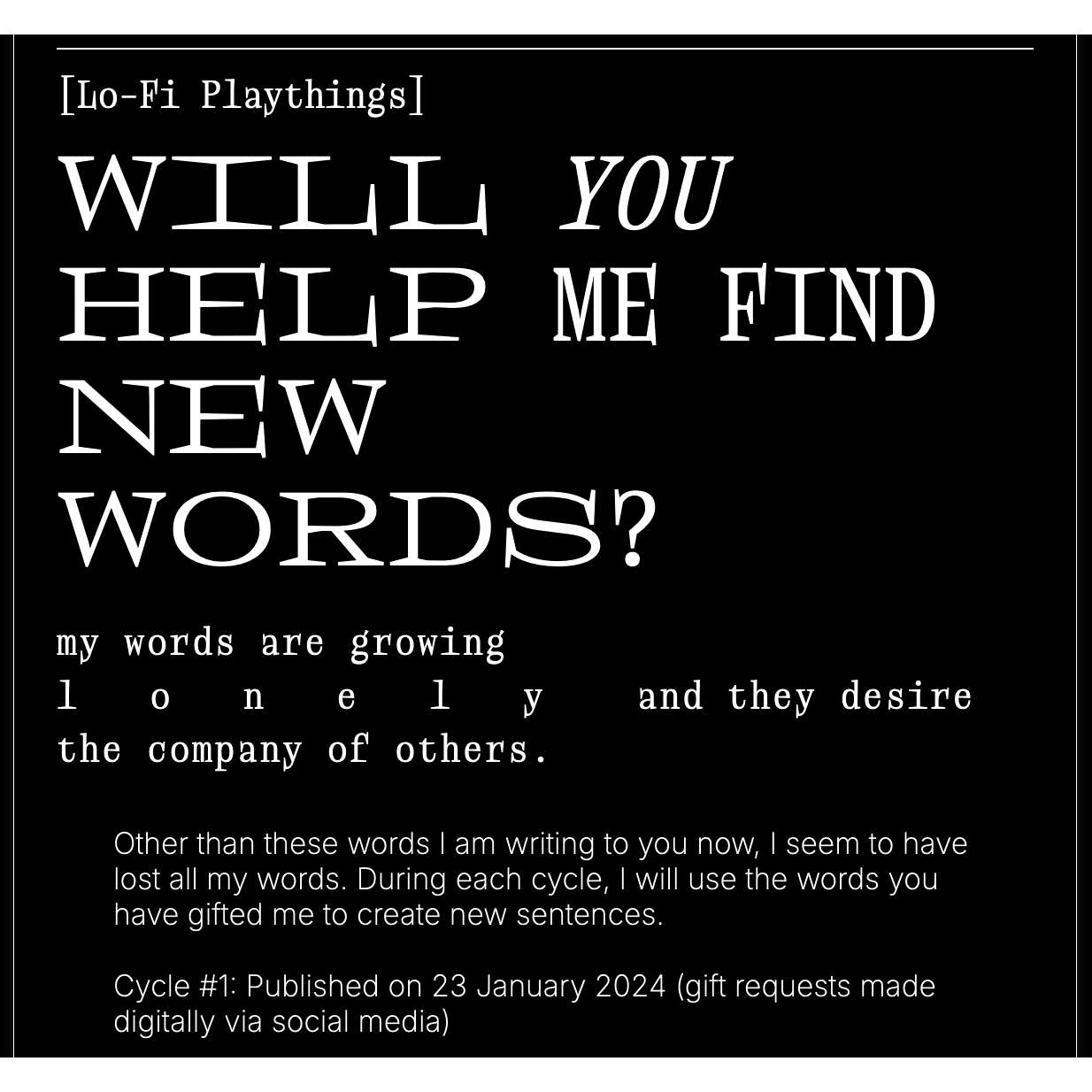
Will You Help Me Find New Words?
︎
Updated: 2025 March 3
Published: 2024 January 23
Author: Kameelah Janan Rasheed
Host: CodePen
Made With: HTML, CSS, JS
Designer: Kameelah Janan Rasheed
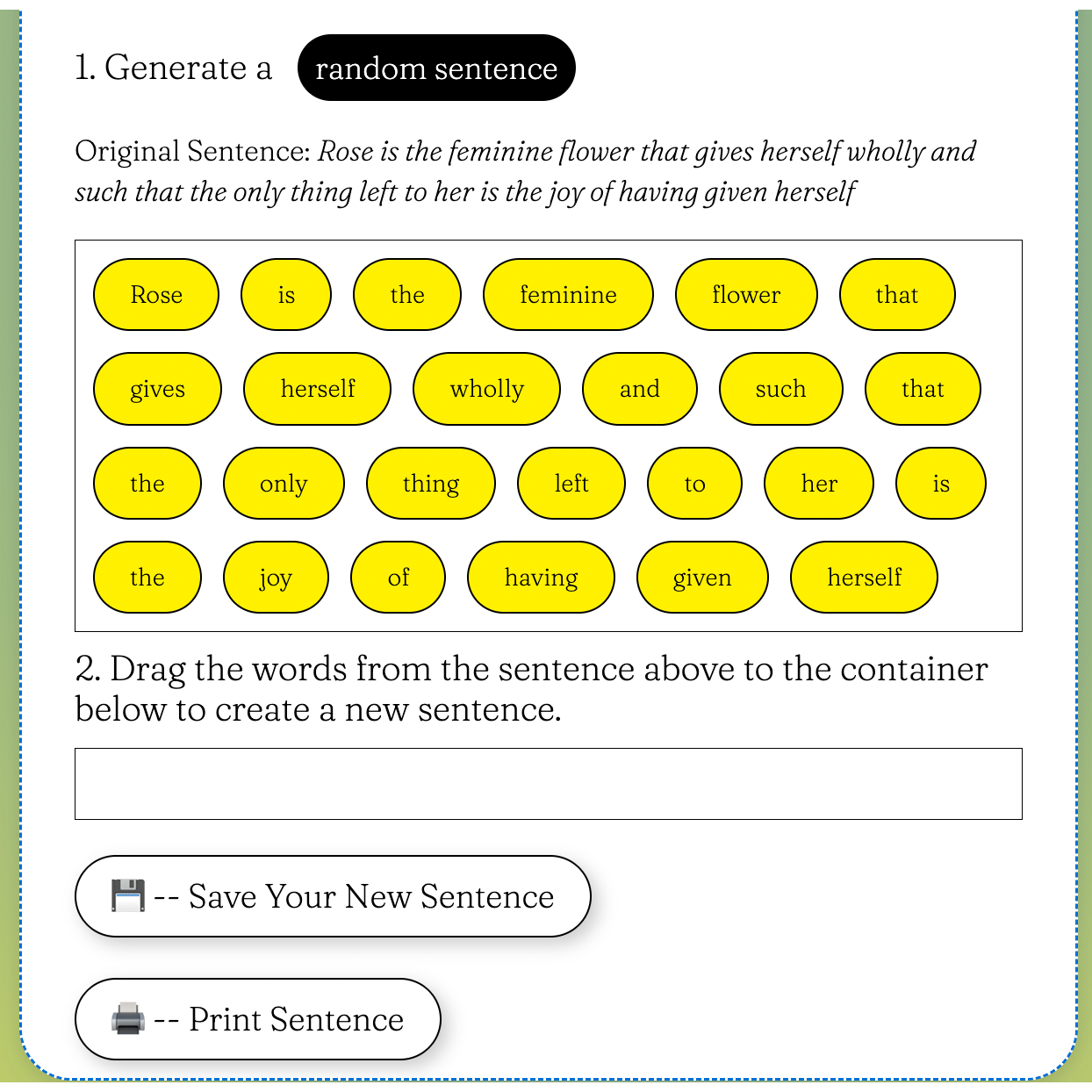
Conjure a New Sentence
︎
After generating a random sentence from Clarice Lispector’s Água Viva (1973), drag individual words and punctuation to create a new sentence.
Updated: 2025 March 3
Published: 2025 Oct 15
Author: Kameelah Janan Rasheed
Host: CodePen
Made With: HTML, CSS, JS; Python
Designer: Kameelah Janan Rasheed
Created at the culmination of the Little Octopus School class.
Updated: 2025 March 3
Published: 2025 Oct 15
Author: Kameelah Janan Rasheed
Host: CodePen
Made With: HTML, CSS, JS; Python
Designer: Kameelah Janan Rasheed

Writing Alongside Água Viva
︎
Updated: 2025 March 3
Published: 2025 Oct 15
Author: Students of the Little Octopus School
Host: CodePen
Made With: HTML, CSS, JS
Designer: Kameelah Janan Rasheed
Scores by: Students in the Little Octopus School course
Thank you, Agnes Pyrchla! Their suggestion to slow down and engage more deliberately with prompts led to the creation of the Google document extension, which invites players to write and share before proceeding to the following prompt.
Designing what I call petite, lo-fi-coded playthings (both simple code and more analog versions) is a reminder that, at their core, these playthings invite other possibilities: what other forms are possible? How can the constraint offered open us up? I believe unpredictability can be provided as a language of liberation. By unpredictability, I mean the welcome disruption of the expected program, the pleasurable unfamiliarity with the unfolding part of the story, and the inability to name what now exists, because no language can even begin to capture it. I do not think liberation is as simple as breaking syntactic structure; however, the analogy of a writing system offers a schema of “waywardness” (as both Emily Dickinson and Sadiya Hartman discuss) and internal rebellion.