 Home
Home
 What's going on?
 Biography
 Ethos
Ethos
 Lists
Lists
 Newsletter
 Visual Art
 Writing
 Teaching
 Programming, Speaking
 Young Kameelah
 Press
Press
 Contact
 Colophon
︎ [consult] Orange Tangent Study ︎ [learning community] Little Octopus School ︎ [libraries, archives, infodumps] Gather & Disperse ︎ [publishing, software] Scratch Disk Full

She stewards KJR Studios , where she studies the poetics and politics of non-compliance and disobedience across written , spoken , and visual communication systems. She makes ( language-saturated installations ) , ( film/video ) , ( performance-adjacent improvisational artist talks ) , ( libraries ) , ( software ) , ( paranormal fiction stories and loglines ) , ( learning environments ) , ( stand-up comedy sets ) , ( wayward translations ) , ( devotional kits ) , ( walking paths ) , ( theremin scores ) , and ( photographs )



[A]: Rasheed, Kameelah Janan (2021)
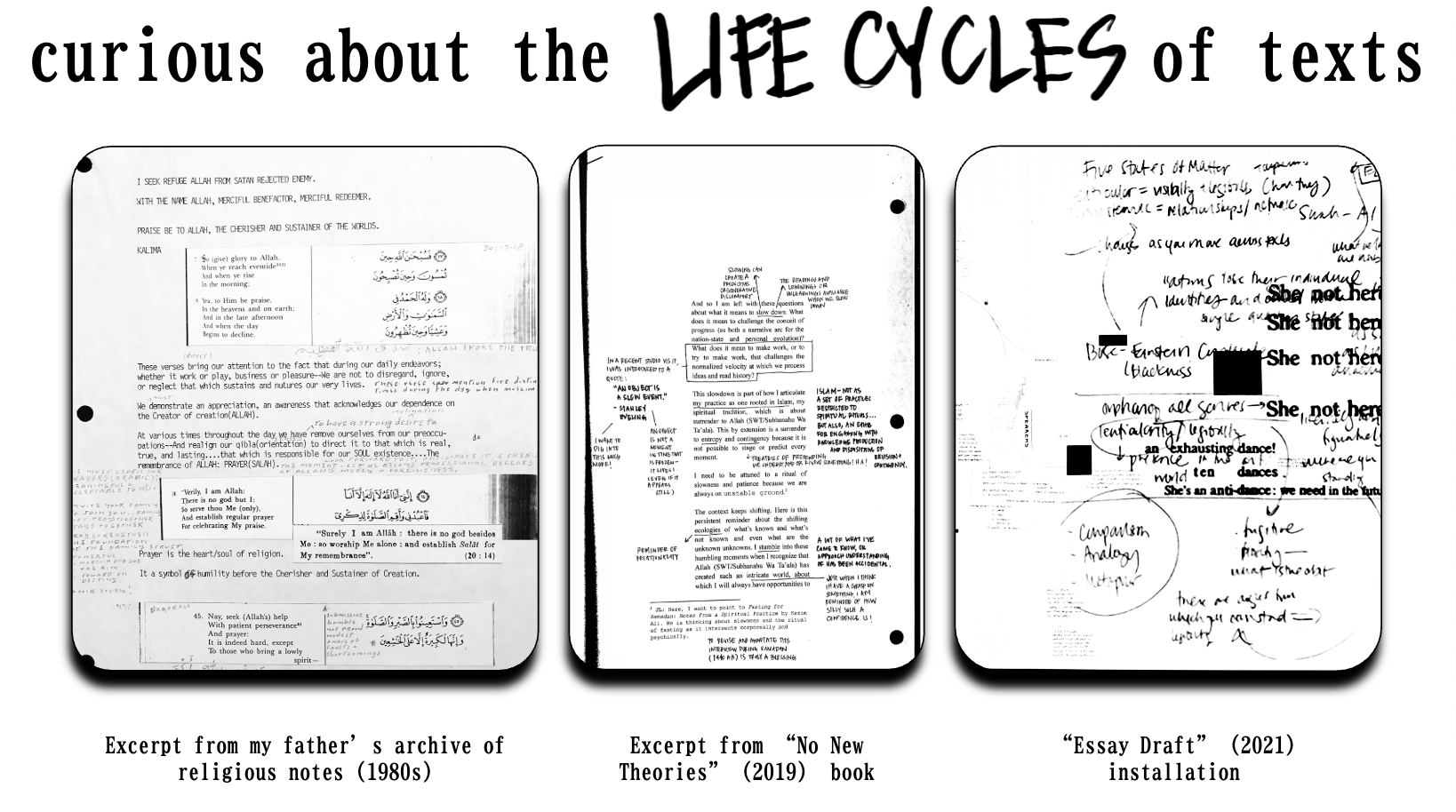
I mean learning as a process of radical slowing down/deceleration in the context of almost compulsory acceleration under the current conditions; an attentiveness to a velocity that allows for a patient and close reading; an engagement with curiosity, serendipity, improvisation, and tangents. Learning is a persistent reminder of the shifting ecologies of what it means to know something.

︎
︎
[C1]: “Semitic Root,” Wikipedia, last modified November 14, 2025, https://en.wikipedia.org/wiki/Semitic_root
︎
[C2]: “Project Root List,” StudyQuran, accessed November 16, 2025, https://studyquran.org/PRL/PRLonline.htm
︎
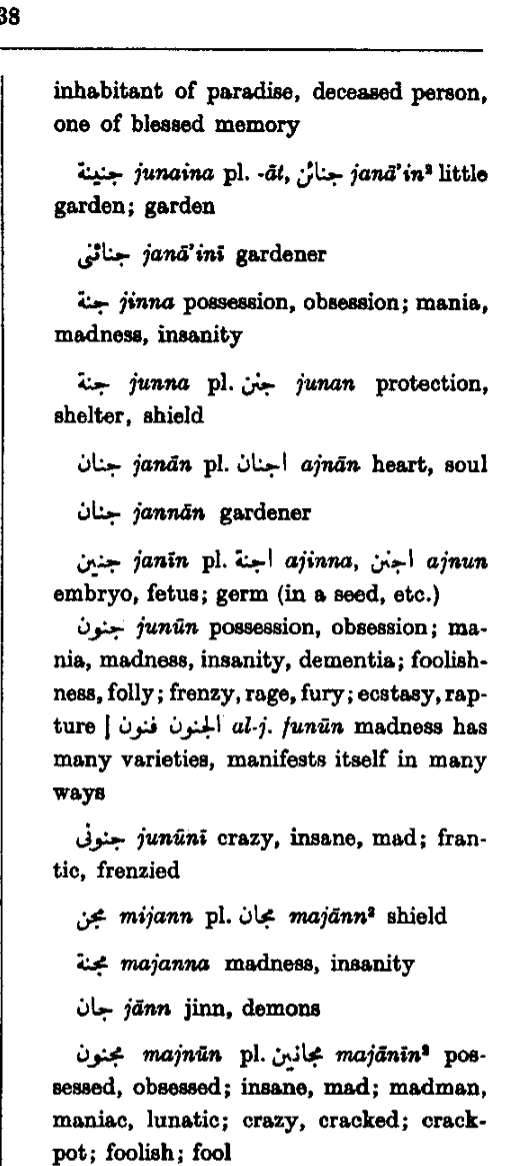
[C3]: Wehr, Hans. A Dictionary of Modern Written Arabic: Arabic-English. 4th rev. ed. Edited by J. Milton Cowan. Ithaca, NY: Spoken Language Services, Inc., 1976.
︎
[D1]: Lispector, Clarice. Água Viva. United States: New Directions, 2012.

[D2]: Acheampong, Michelle, “Kameelah Janan Rasheed on Learning and Unlearning,” Art in America, July 1, 2021.
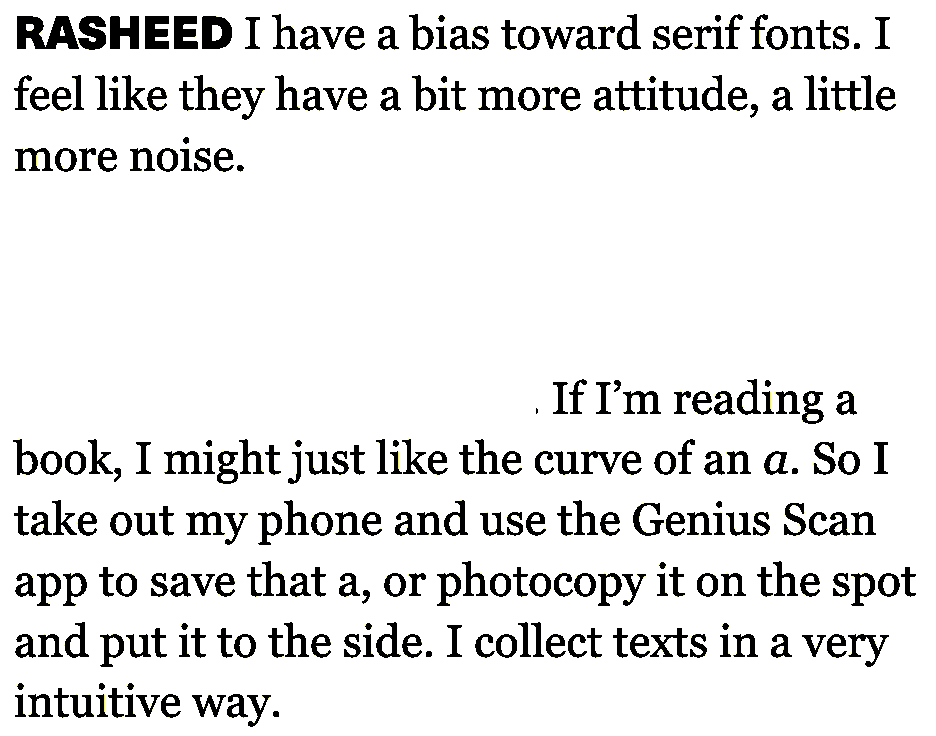
[D3]: Syllables of Velvet” and “Sentences of Plush” in Emily Elizabeth Dickinson’s 1862 letter to Eudocia C. Flynt.
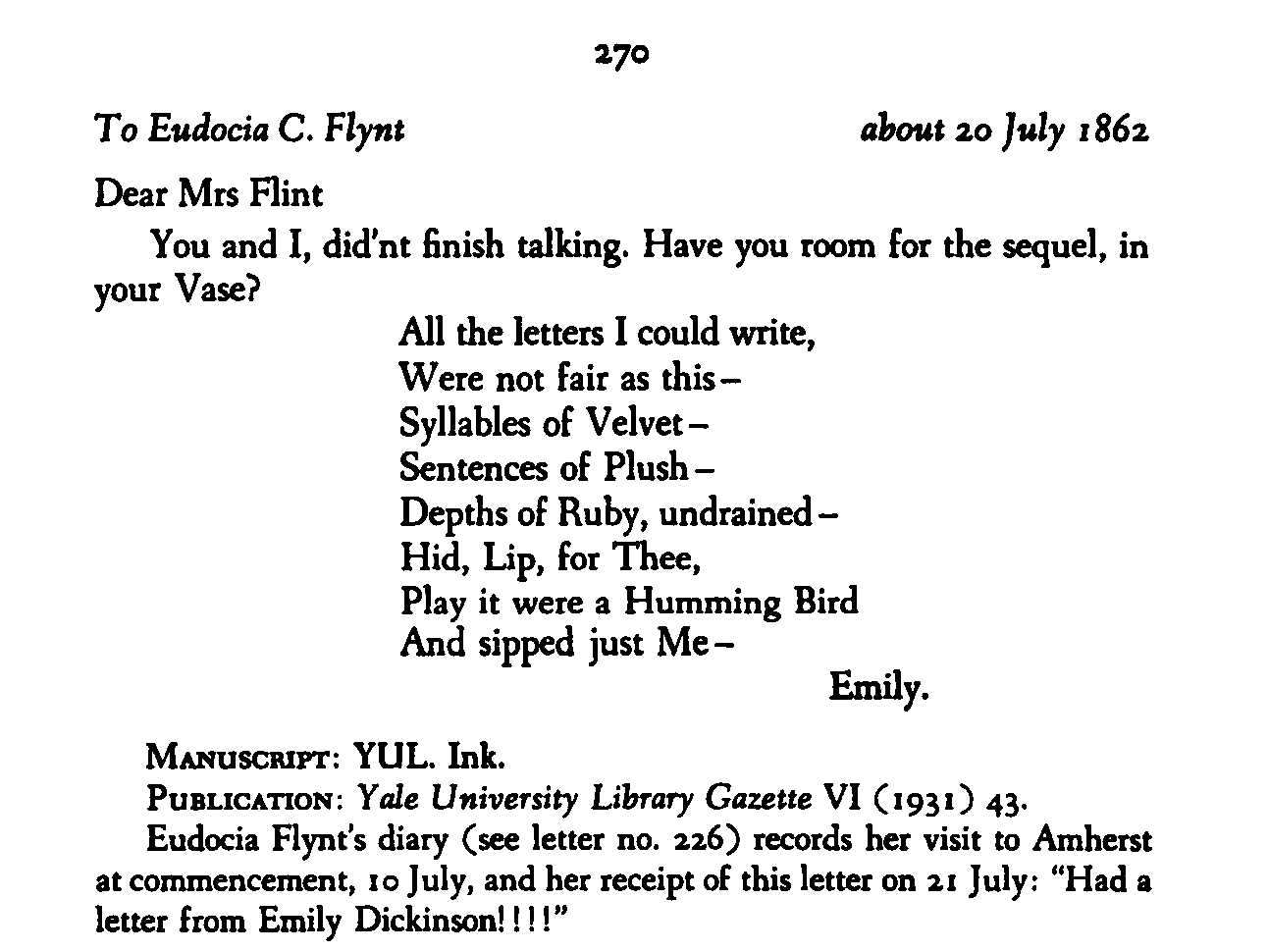
[D4]: Rasheed, Kameelah Janan (2023)
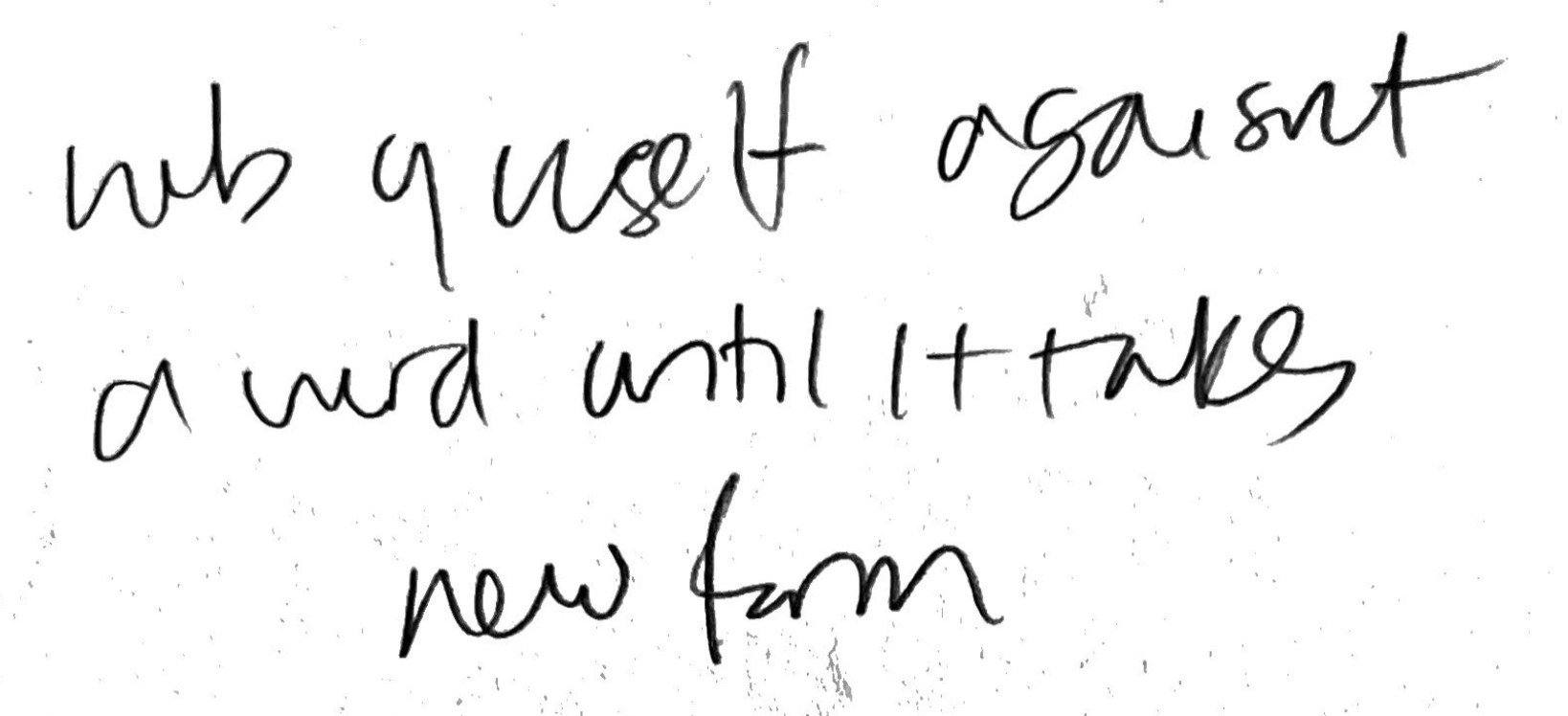
︎
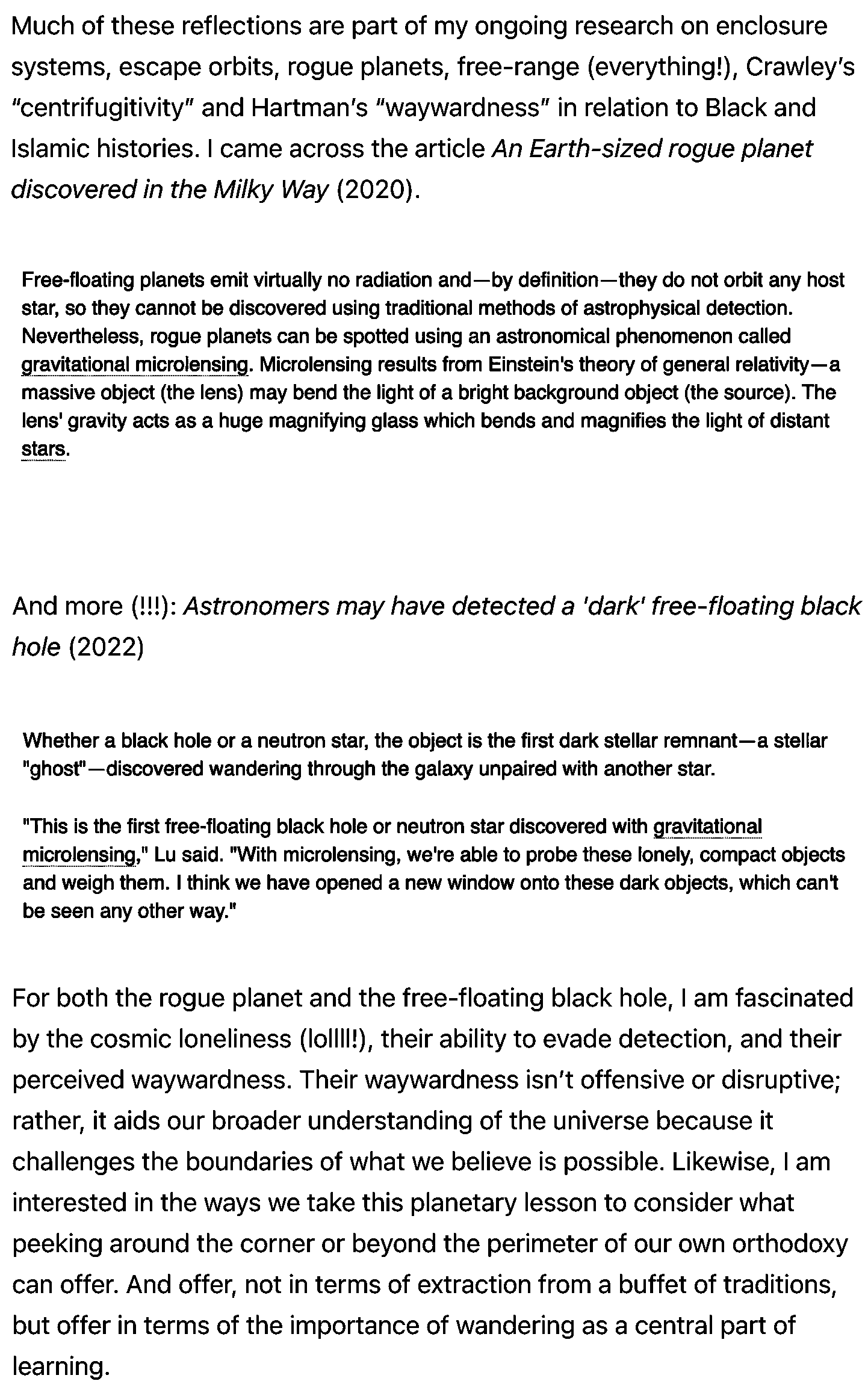
[E1]: Hartman, Saidiya. Wayward Lives, Beautiful Experiments: Intimate Histories of Riotous Black Girls, Troublesome Women, and Queer Radicals. United States: W. W. Norton, 2019.; Emily Elizabeth Dickinson’s Letters (The Atlantic, 1862, L271 and L265)

︎
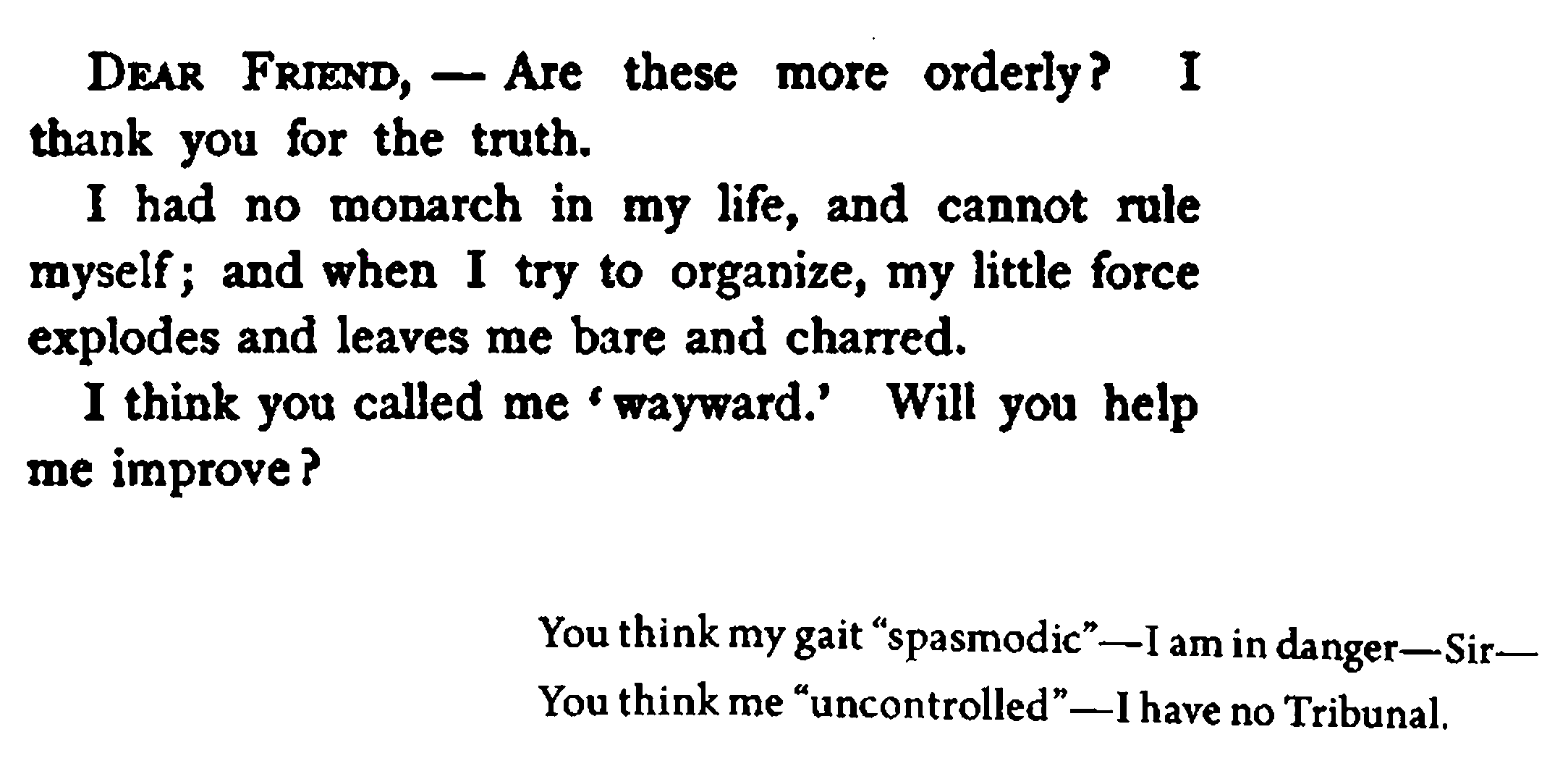
[E2]: Rasheed, Kameelah Janan (2023; 2021)
︎

︎
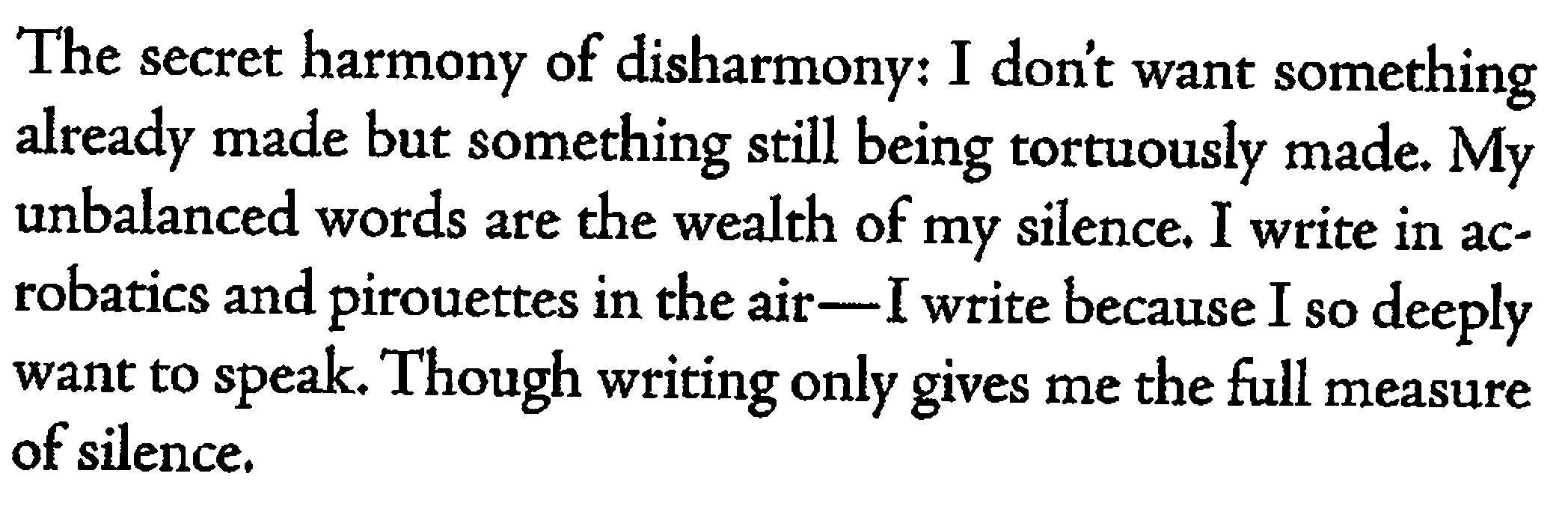
[F]: Lispector, Clarice. Água Viva. United States: New Directions, 2012.
︎
[G]: Emily Elizabeth Dickinson’s Letters (The Atlantic, 1862, L271 and L265)
︎
[H]: Renee Gladman and Fred Moten: One Long Black Sentence. United States: Image Text Ithaca, 2020.

︎
[I]: Imamura, “Escape Velocity,” last modified (n.d.), University of Oregon, accessed November 15, 2025, https://pages.uoregon.edu/imamura/121/lecture-4/escape.html

︎
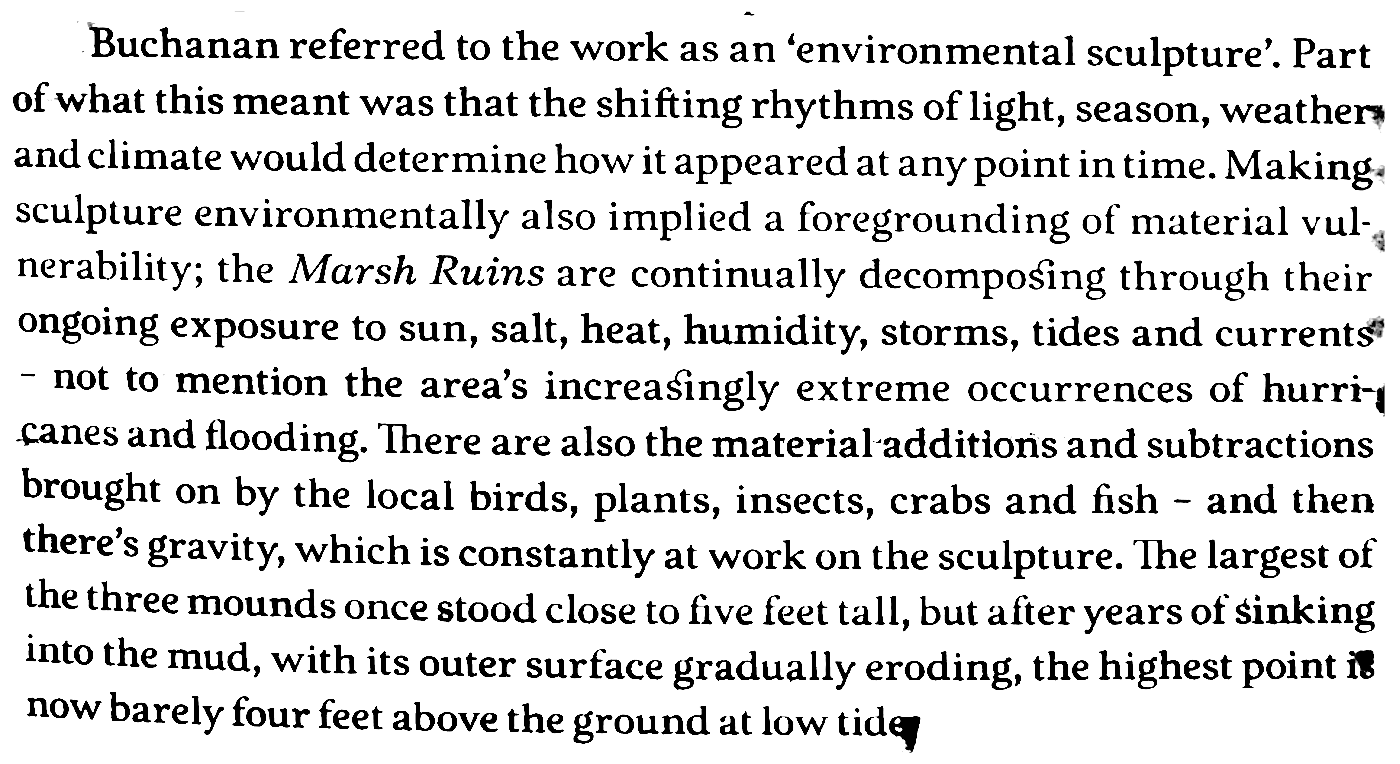
[J]: Groom, Amelia. Beverly Buchanan: Marsh Ruins. United Kingdom: MIT Press, 2021.
︎
[K]: Rasheed, Kameelah Janan (2020)

︎
[L]: Gladman, Renee. Calamities. United States: Wave Books, 2020.
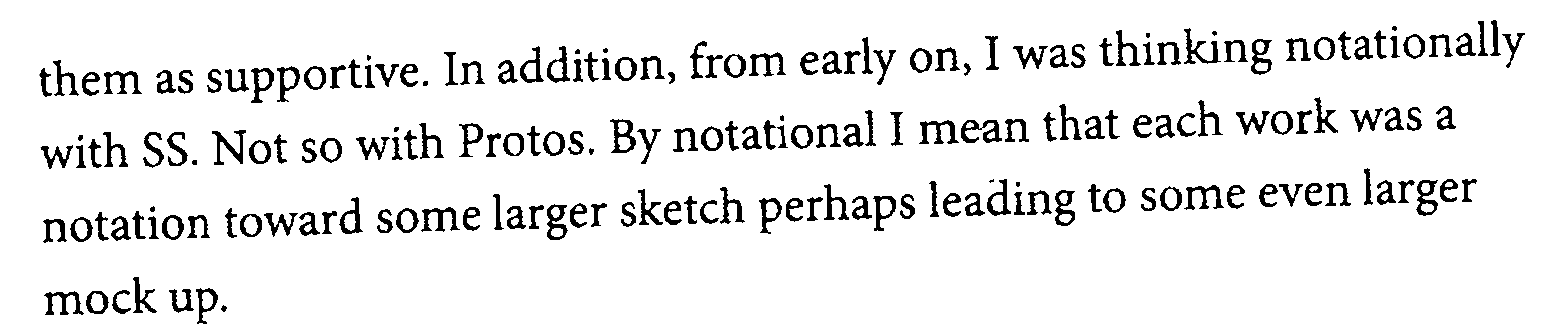
 While texting with a friend (writer Zoe Hopkins) and interlocutor for another project, I mentioned that the compositional field of Google Docs felt restrictive. I wanted to swell beyond the compositional field of the word processor, as I wanted to exceed the page, so I went to the walls. Across three frantic messages, I shared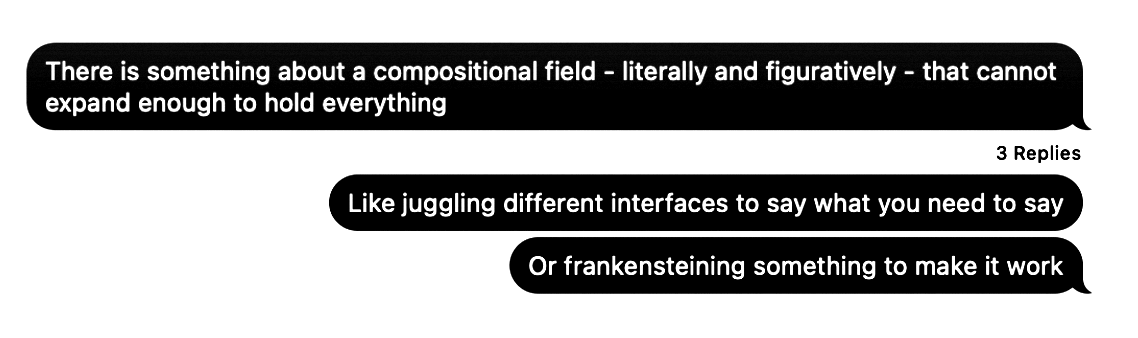
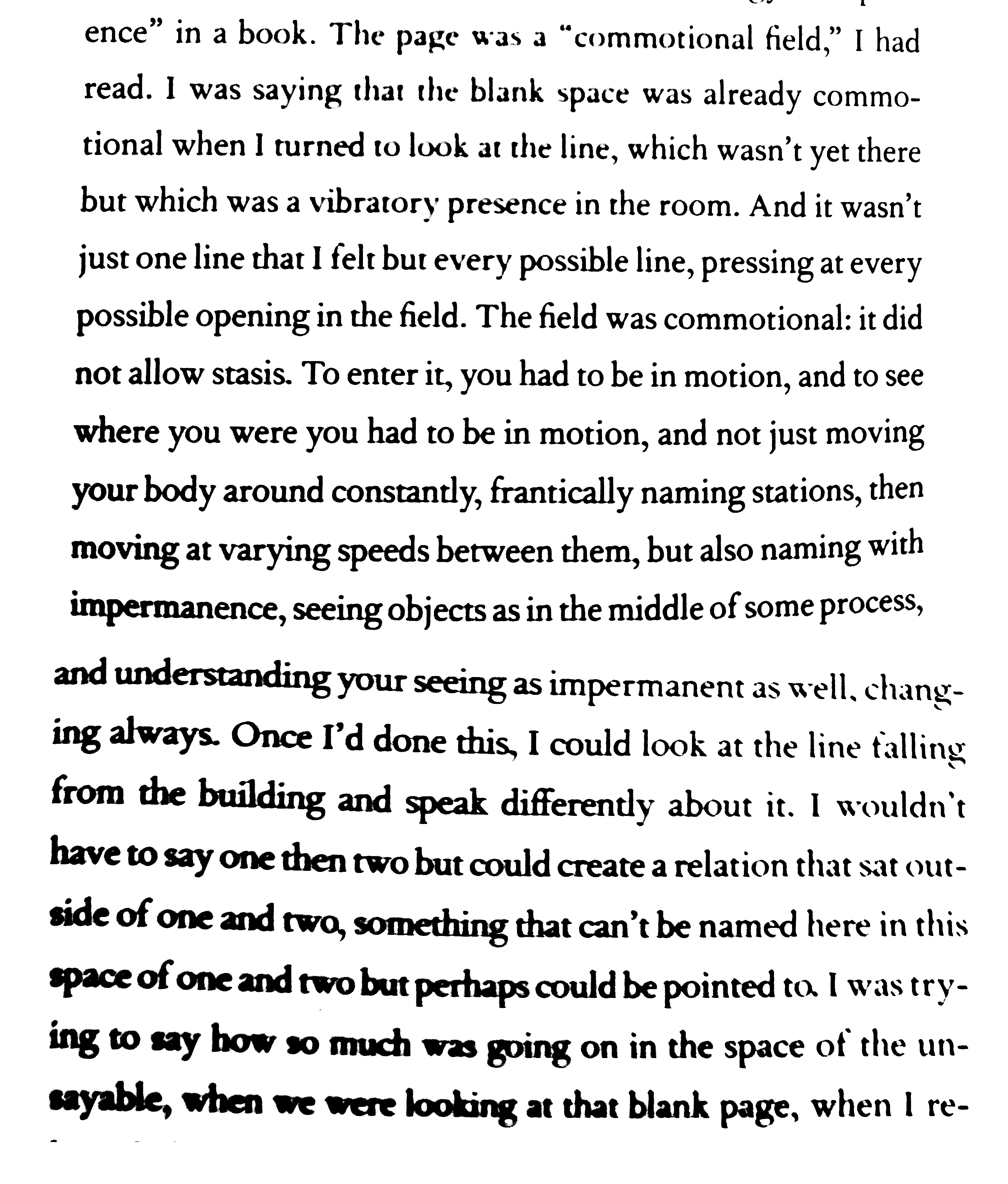
In this meandering, she asked if I’d heard of Renee Gladman’s “commotional field” in Calamities (2016). I had not. To be honest, I felt betrayed, not from this friend, but of myself. I’d purchased Calamities years ago, and in working my way through a stack of books, I had not reached the shore of this text. I grabbed the book off my “need to read” shelf and began to read frantically. The commotion is riotous and disobedient. The compositional field refuses to settle. A compositional field speaks to the environment in which the writing occurs. Gladman’s articulation is almost an exponential expansion – that the compositional field has energy and affordances.
︎
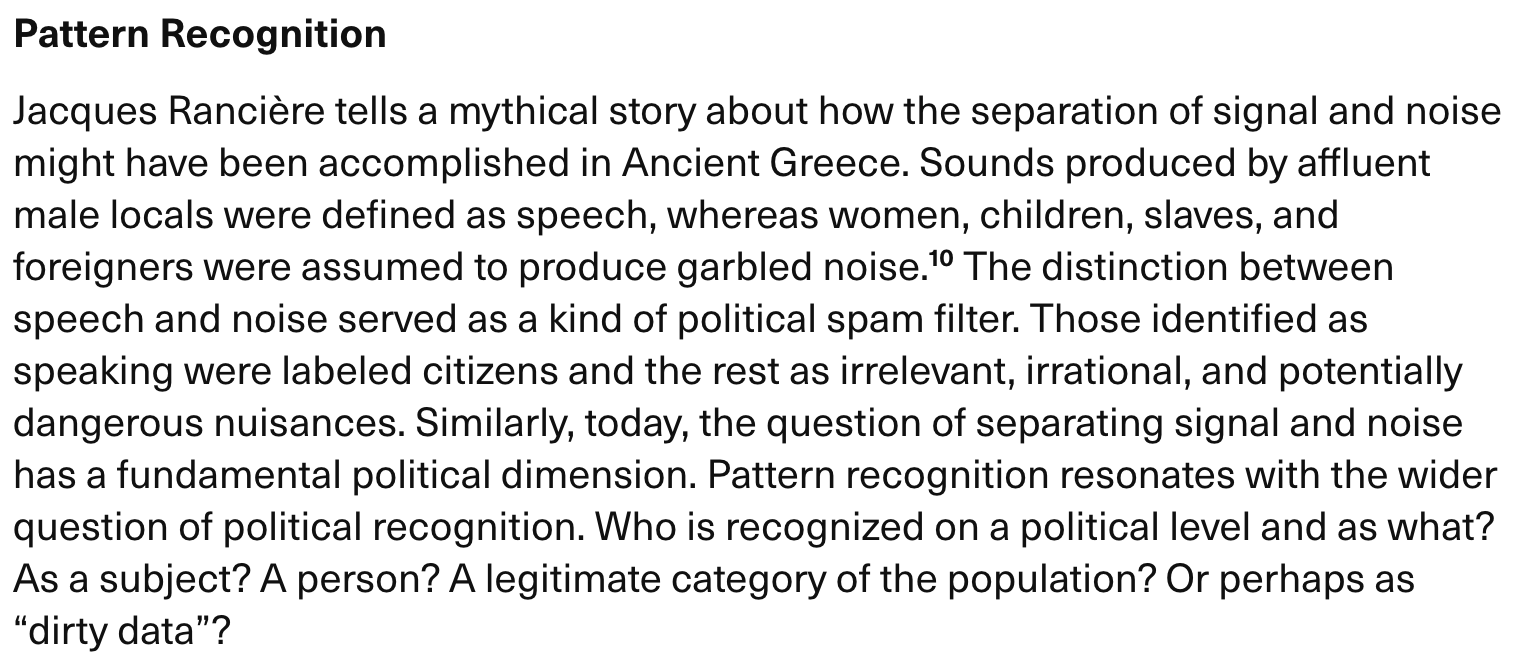
[M]: Steyerl, Hito. “A Sea of Data: Apophenia and Pattern (Mis-)Recognition.” E-Flux, April 2016.
︎
[N]:

︎
︎
[P]: “Multisensory integration — Neuroscience.” ScienceDirect. Accessed December 1, 2025. https://www.sciencedirect.com/topics/neuroscience/multisensory-integration.


Last Updated: 1 September 2026
Table of Contents:






















Lispector, Clarice. Água Viva. United States: New Directions, 2012
︎

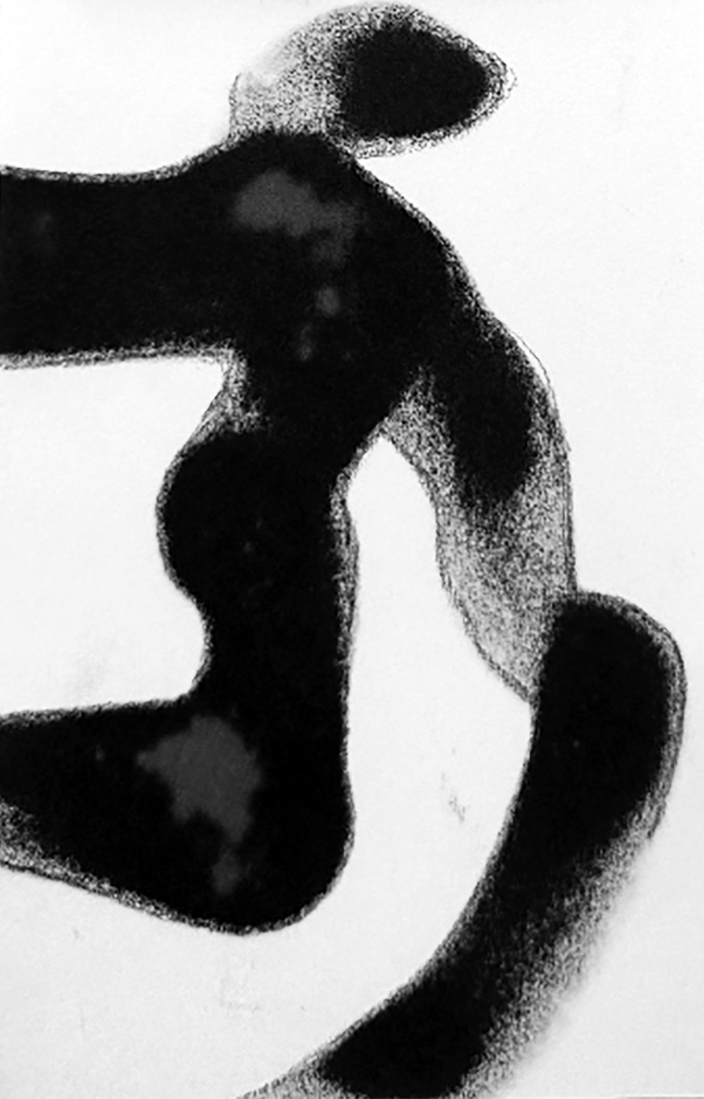
Pope.L. Proto-Skin Set. New York, NY: Mitchell-Innes & Nash, 2017
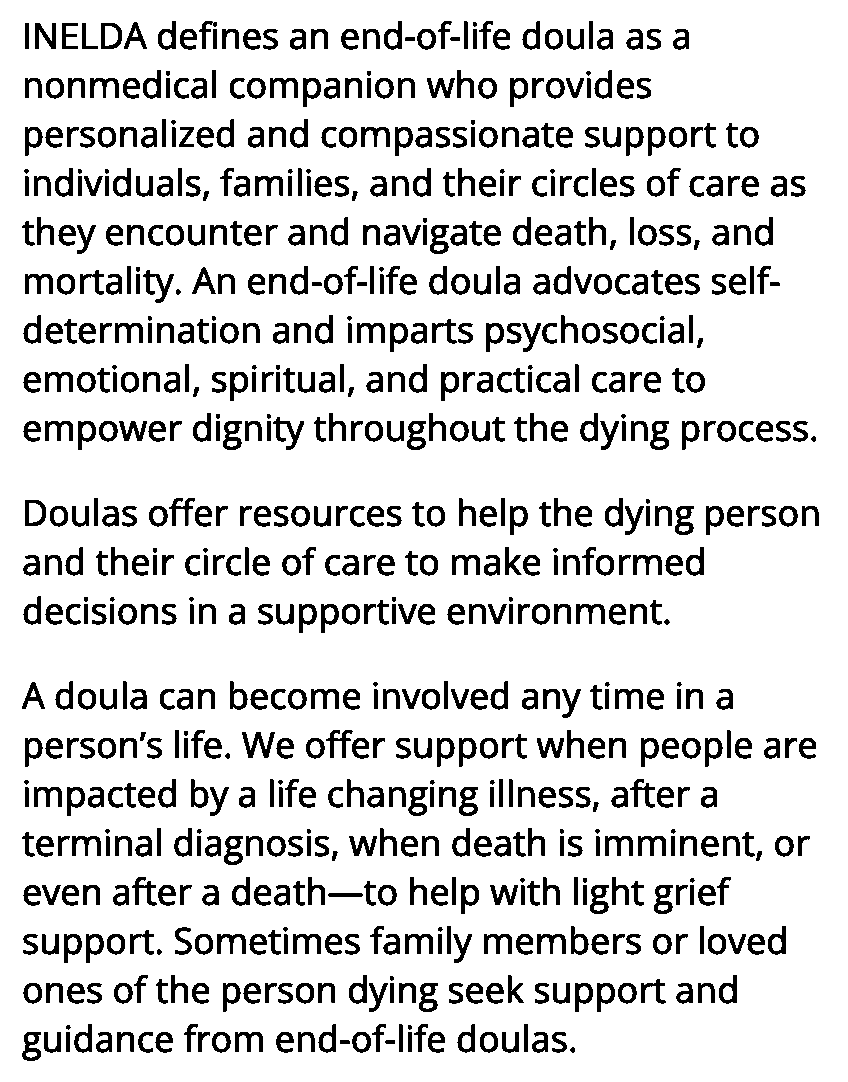
I am a learner [A] and a death doula [B] in training.

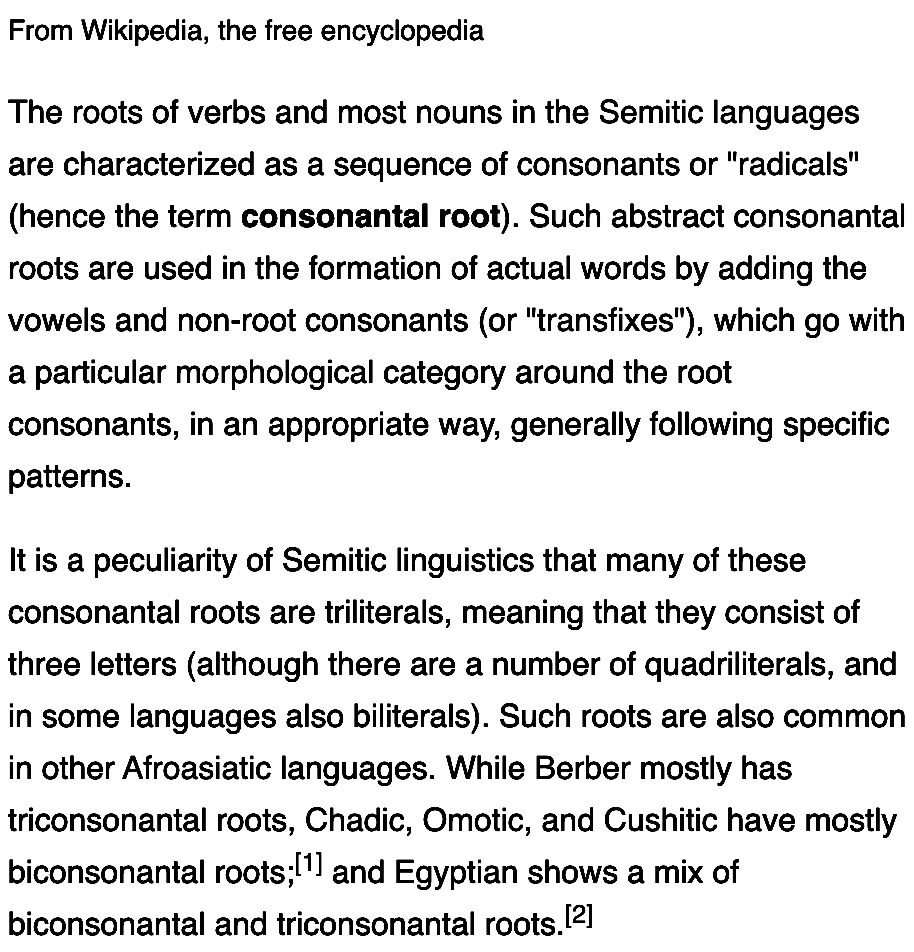
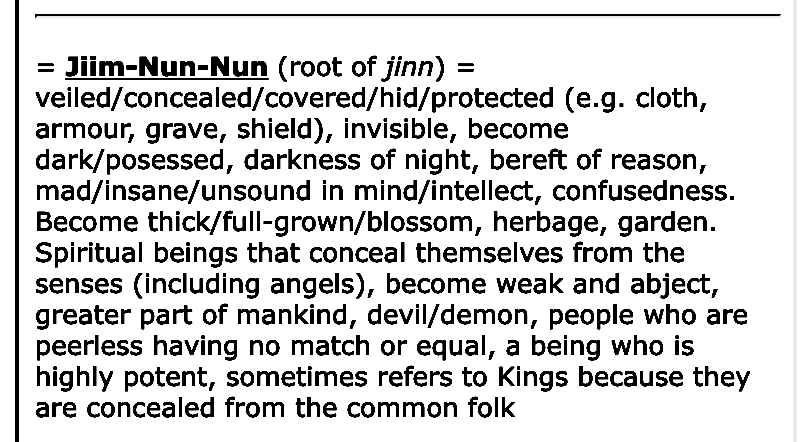
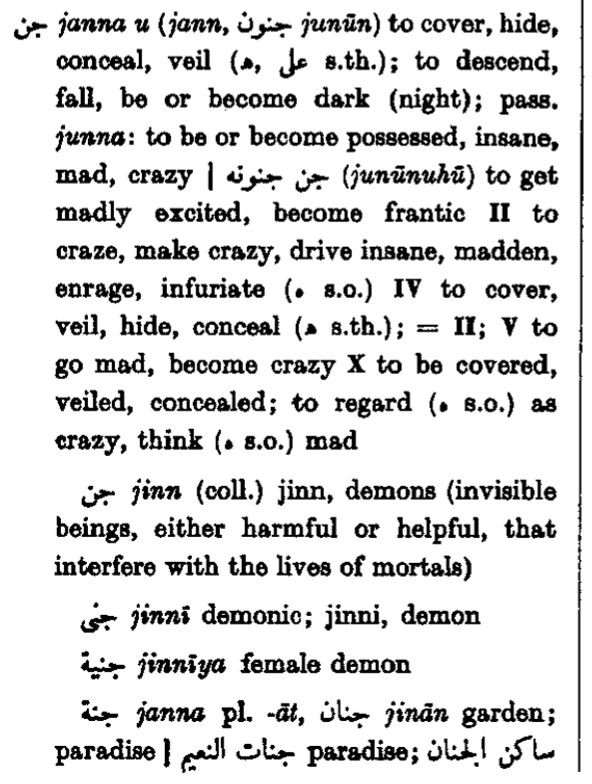
My middle name, Janan, meaning heart and soul, comes from the Arabic triliteral root [C1] (J-N-N / جنان) [C2, C3] , evoking for me that which is unmoored, veiled, and wayward.
I consider the radical possibilities of noise, unintelligibility, discrepancy, and the refusal of frictionless understanding. Across my practice at KJR Studios – an ecosystem spanning installation, publishing, pedagogy, performance, archival practice, and death care – I study what regimes and institutions label “noise”: the communities, the bodies, the gestures, the utterances, and the forms of life that manage to exceed systems designed for certainty, extraction, and linearity.
Coherence and logic overdress the sentence, building a thick
membrane that disinvites deviation. The absurd can undress the
word (and the world), creating a more porous membrane that allows
contamination, a slow erosion of the seam, and a collision of edges.



I examine the
materiality[D1, D2, D3, D4]
of
wayward [E1, E2]
language:
acrobatic sentences [F]
(Clarice Lispector);
anarchical stanzas with no recognized
monarch [G]
(Emily Elizabeth Dickinson);
phrases with trapdoors or
underground railroads [H]
(Fred Moten); runaway syllables that scatter to the marooned edges
of a page; words that
escape the orbit [I]
of their mother sentence; footnotes that consume their reference;
and ecstatic outbursts that dissipate before being recorded.
The page as a medium/carrier/ substrate/surface, stage (a context for something to happen) substrate/surface, stage with its own lifecycle: an active, “materially vulnerable” (Amelia Groom) [J] , vibratory [K] “commotional field” [L] (Renee Gladman).
The page as a medium/carrier/ substrate/surface, stage (a context for something to happen) substrate/surface, stage with its own lifecycle: an active, “materially vulnerable” (Amelia Groom) [J] , vibratory [K] “commotional field” [L] (Renee Gladman).


Rasic, Dunja. The Written World of God: The Cosmic Script and the Art of Ibn'Arabi. United Kingdom: Anqa Publishing, 2021.

Twisting against the circumference of these systems produces
unrewarded excess: energy, sounds, marks, gestures, meanings,
and affects that leak, sometimes covertly, beyond their sanctioned
limits. But the twisting also builds up potential energy.
excess:
an amount of something that is more than necessary,
permitted, or desirable.
leak: (written in 2021) - I want to offer leakiness as a liberatory technology--leakiness or the porous boundaries between rituals (syncretism); leakiness or the porous borders between bodies of text (intertextuality); leakiness or the porous boundaries between modes of communication (across language systems, across substrates, across species, across disciplines, across temporalities). Leakiness is a politics of intimacy: an invitation to wander and wade in the wet; to touch and make anew what has not been made solid; to [un]know and [un]learn; to return to the scene of presumed certainty for revision. Leakiness is a kind of interdisciplinarity, or a yearning to move, to be alive in many ways - to be without the grasp of a body of knowledge or a narrative arc. It is to be imminent in ways that exceed the predictability of a singular discipline.
leak: (written in 2021) - I want to offer leakiness as a liberatory technology--leakiness or the porous boundaries between rituals (syncretism); leakiness or the porous borders between bodies of text (intertextuality); leakiness or the porous boundaries between modes of communication (across language systems, across substrates, across species, across disciplines, across temporalities). Leakiness is a politics of intimacy: an invitation to wander and wade in the wet; to touch and make anew what has not been made solid; to [un]know and [un]learn; to return to the scene of presumed certainty for revision. Leakiness is a kind of interdisciplinarity, or a yearning to move, to be alive in many ways - to be without the grasp of a body of knowledge or a narrative arc. It is to be imminent in ways that exceed the predictability of a singular discipline.
And in an increasingly
automated society
driven by the logic of efficiency at all costs,
this excess must be “dealt with” through the disciplinary
technologies of standardization, compression, containment,
and annihilation.
When you hop off the teleological train headed to wherever
has been deemed an acceptable destination, you fall into a
void of unintelligible noise.
Unreadable and unreachable.
That void is out of sight.
How convenient is that?
You can’t see me.
You can’t find me.
I am not showing up in the database.
There is a glitch.
There is a 404 error.
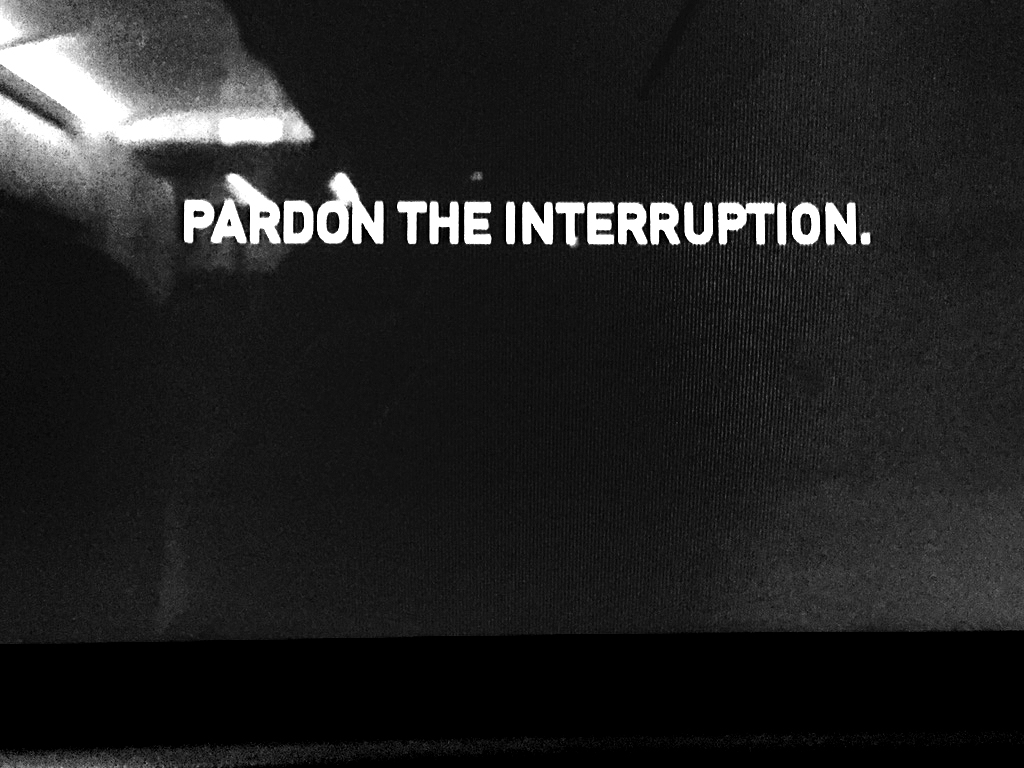



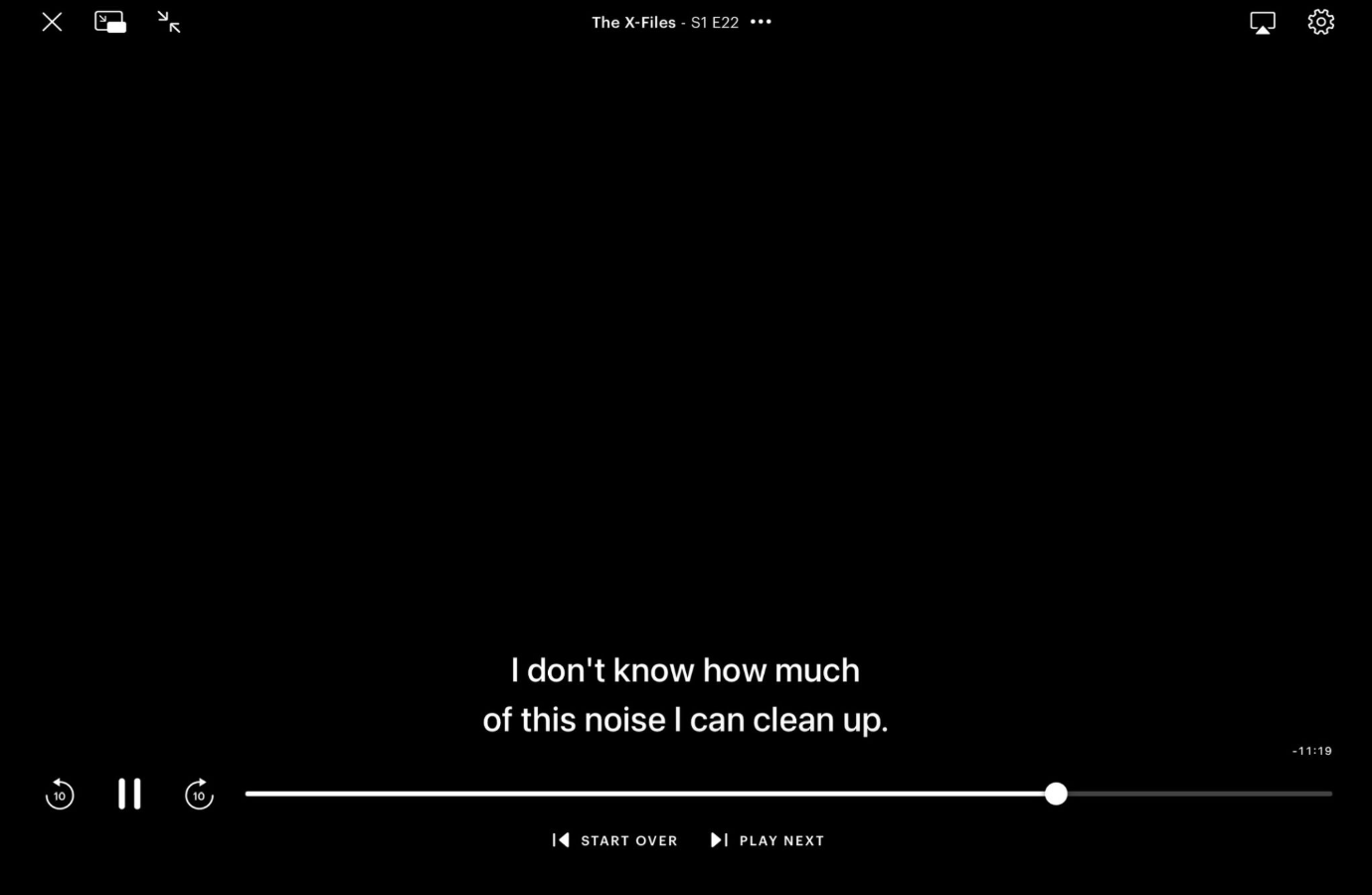
We throw off the logic of management, standardization,
and optimization to recalibrate our capacity to inhabit
and praise ambiguity, incompletion, friction, deferred or
even never-arriving intelligibility.
︎
(What is noise?)
︎
Attali, Jacques. Noise: The Political Economy of Music. United Kingdom: University of Minnesota Press, 1985.

We stay with the noise.


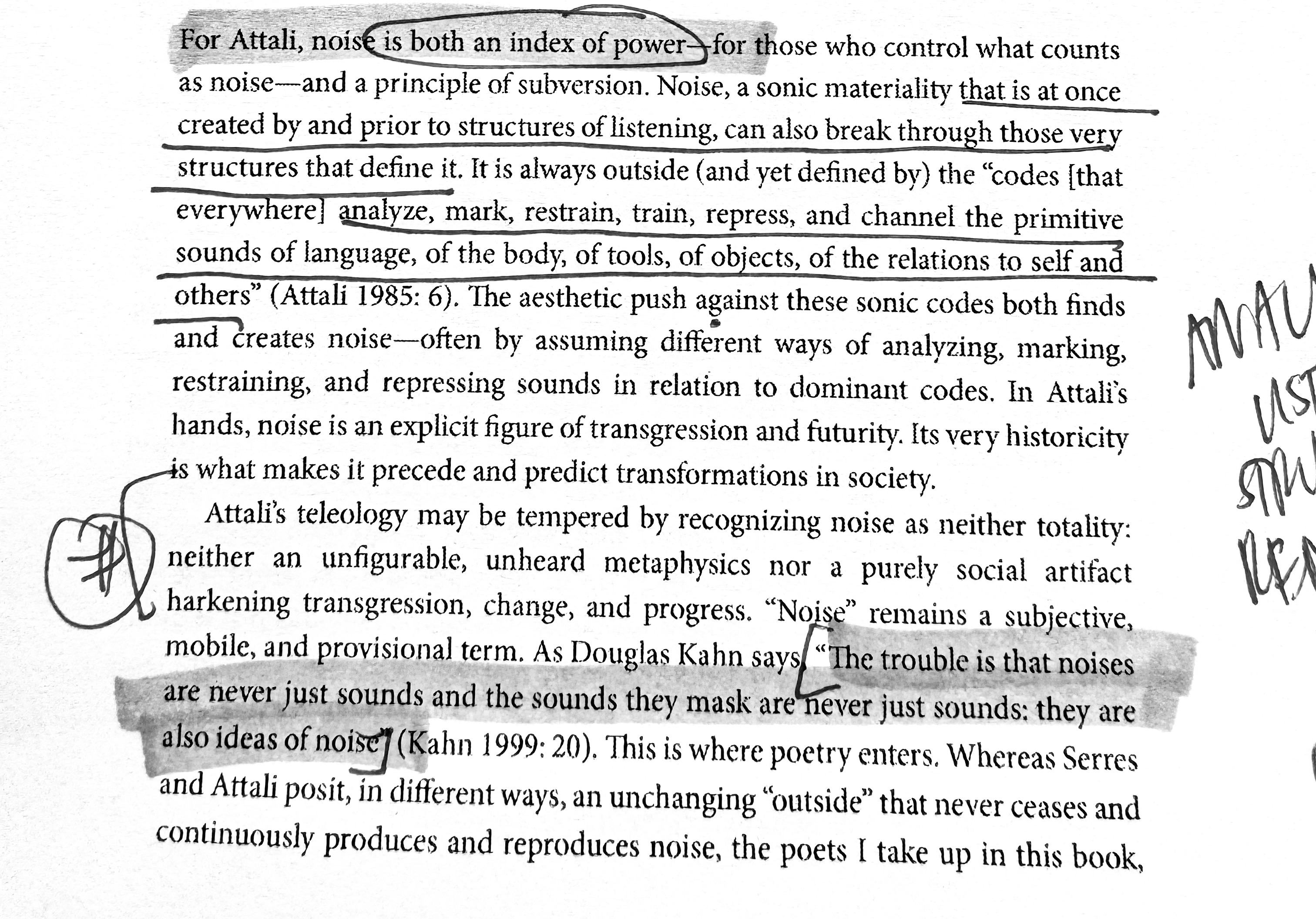
Melillo, John. The Poetics of Noise from Dada to Punk. India: Bloomsbury Publishing, 2020.


Emily Ogden: On Not Knowing: How to Love and Other Essays (2021)
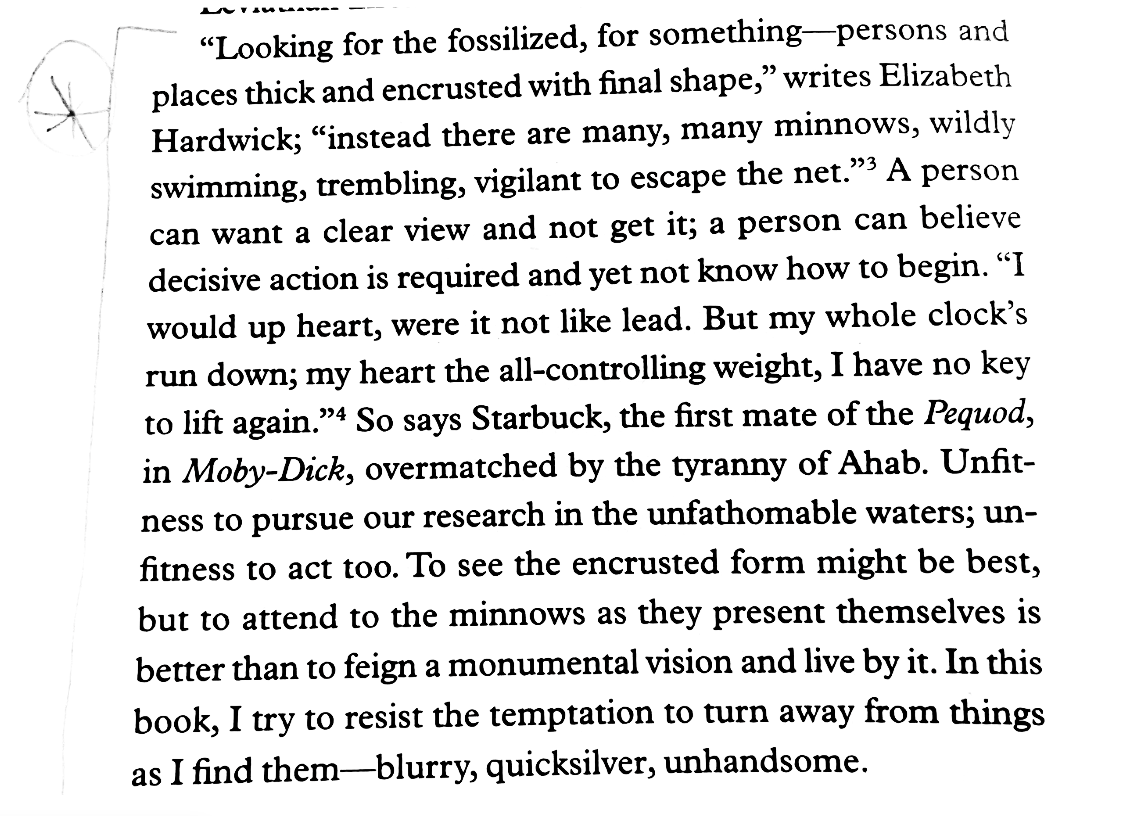


Genette, Gerard. Paratexts: Thresholds of Interpretation. United Kingdom: Cambridge University Press, 1997.
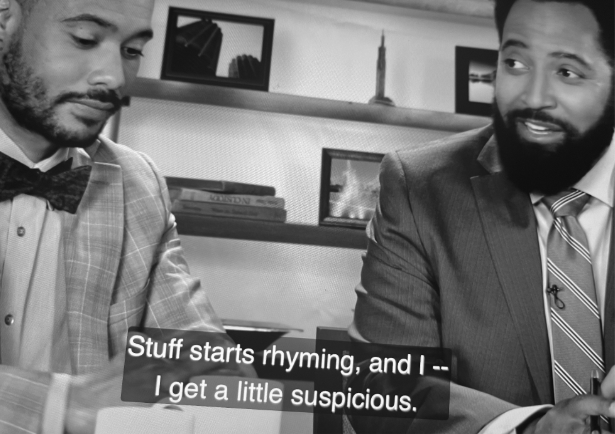
And what is the “proper use” of
noise[M]
?
I turn to Nathaniel Mackey’s Discrepant Engagement: Dissonance, Cross-Culturality, and Experimental Writing (1993). Invoking Charles Olson’s “keep their proper confusions,” and Braithwaite’s “calibanisms,” Mackey reminds us that noise and discrepancy can awaken a “suspicion of totalizing paradigms.” I grow suspicious of things that make too much sense— a sentence that weaves itself together too effortlessly, a phrase that settles too comfortably on my tongue.
Noise is a context for learning more about my relationship to plot, rationality, and immediacy:
I turn to Nathaniel Mackey’s Discrepant Engagement: Dissonance, Cross-Culturality, and Experimental Writing (1993). Invoking Charles Olson’s “keep their proper confusions,” and Braithwaite’s “calibanisms,” Mackey reminds us that noise and discrepancy can awaken a “suspicion of totalizing paradigms.” I grow suspicious of things that make too much sense— a sentence that weaves itself together too effortlessly, a phrase that settles too comfortably on my tongue.
Noise is a context for learning more about my relationship to plot, rationality, and immediacy:
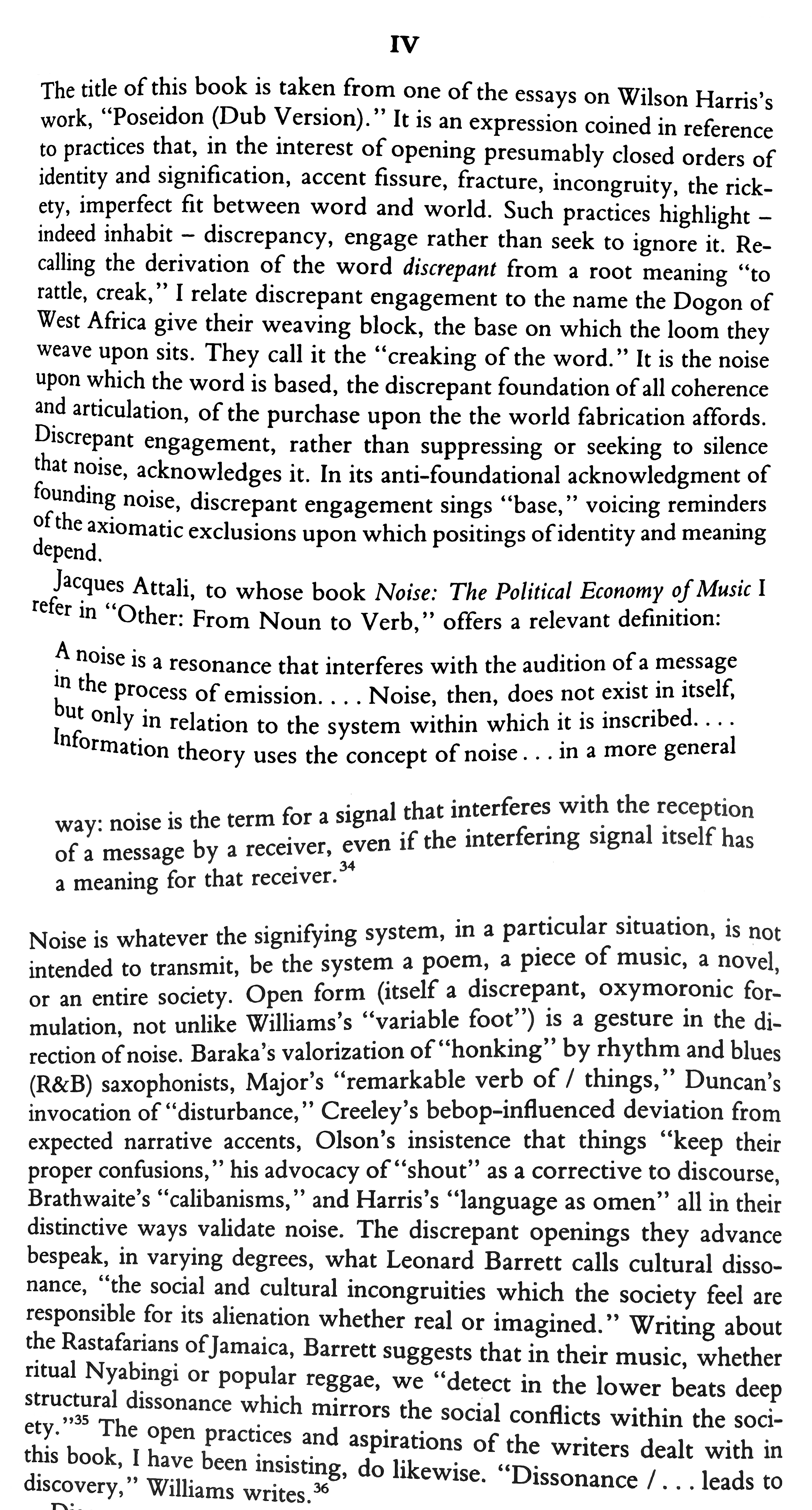
As we listen for what exceeds the signal — what escapes
intelligibility and standard perception — I look to instances
presumed to be failures: latency, misalignment, and
ectopia[N]
.
In this turn toward error as method instead of aberration,
noise becomes an invitation to other ways of knowing.
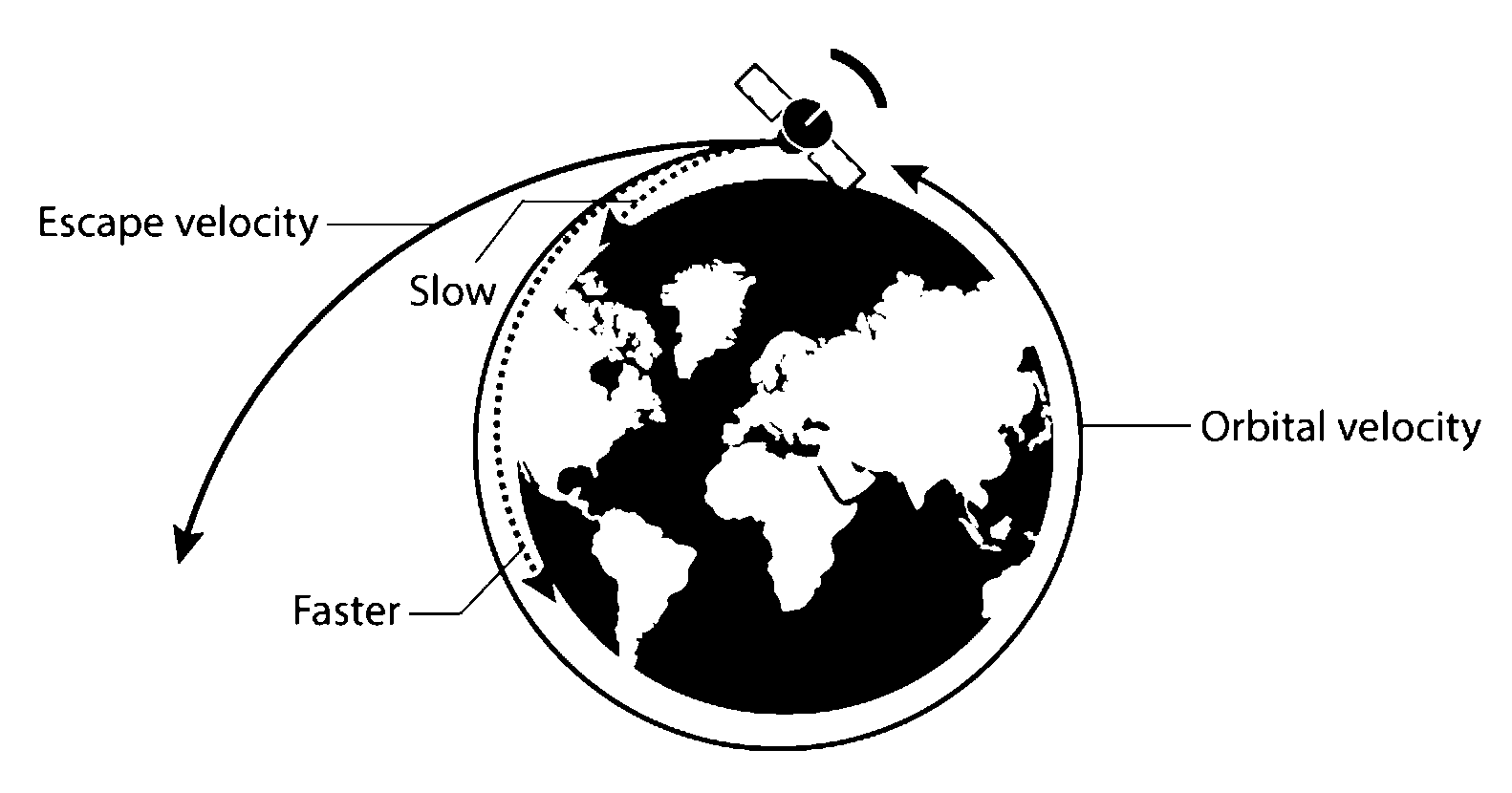
Resisting the temptation to worship at the altar of coherence
and immediacy, my work considers strategies of being out of sync,
non-compliant, and excessive.
These considerations are an affront to data ingestion but also
an authentic outlay of how I process the world: sprawling,
iterative, associative, speculative, often occluded, and,
most importantly, unfinished.

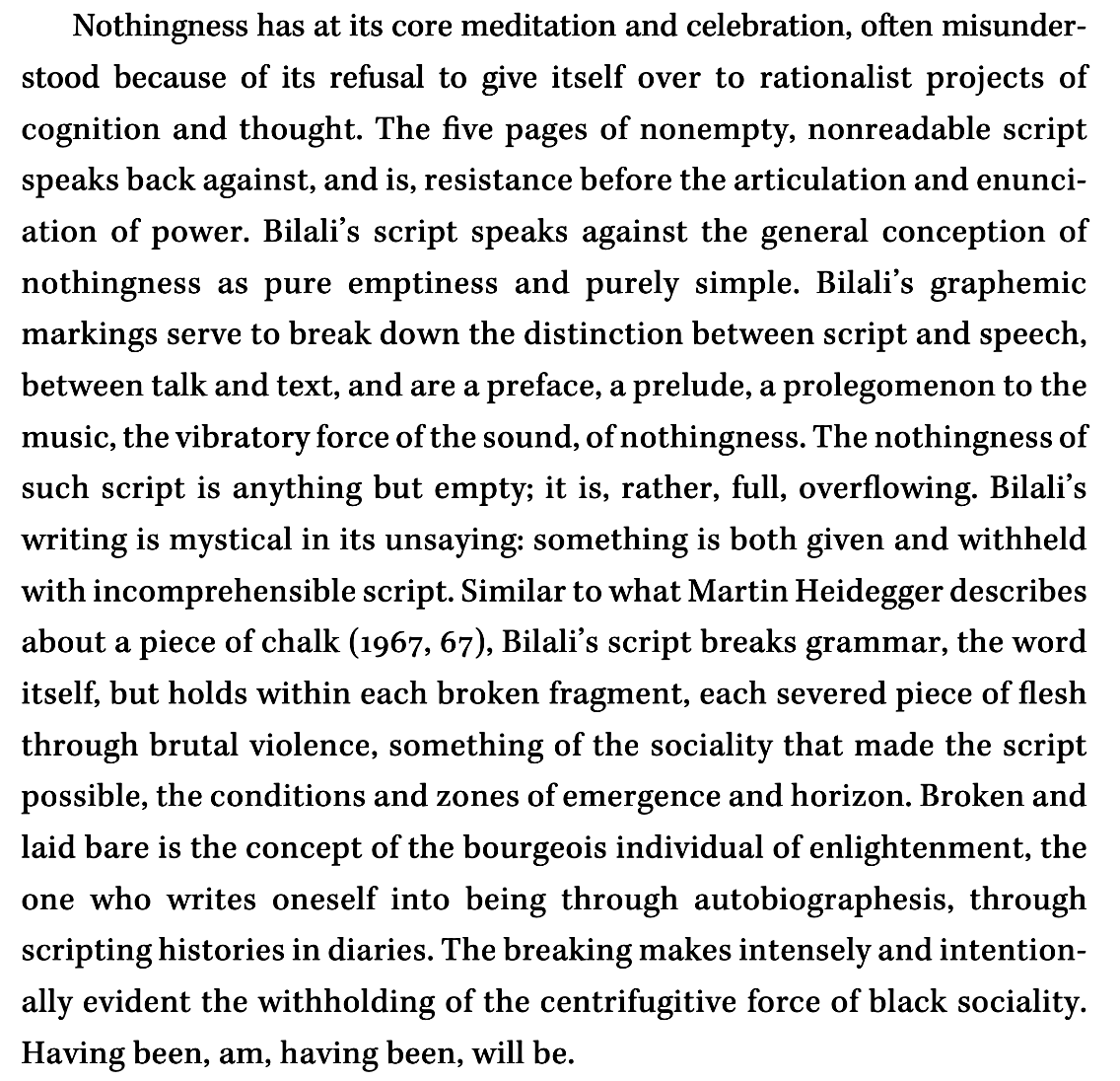
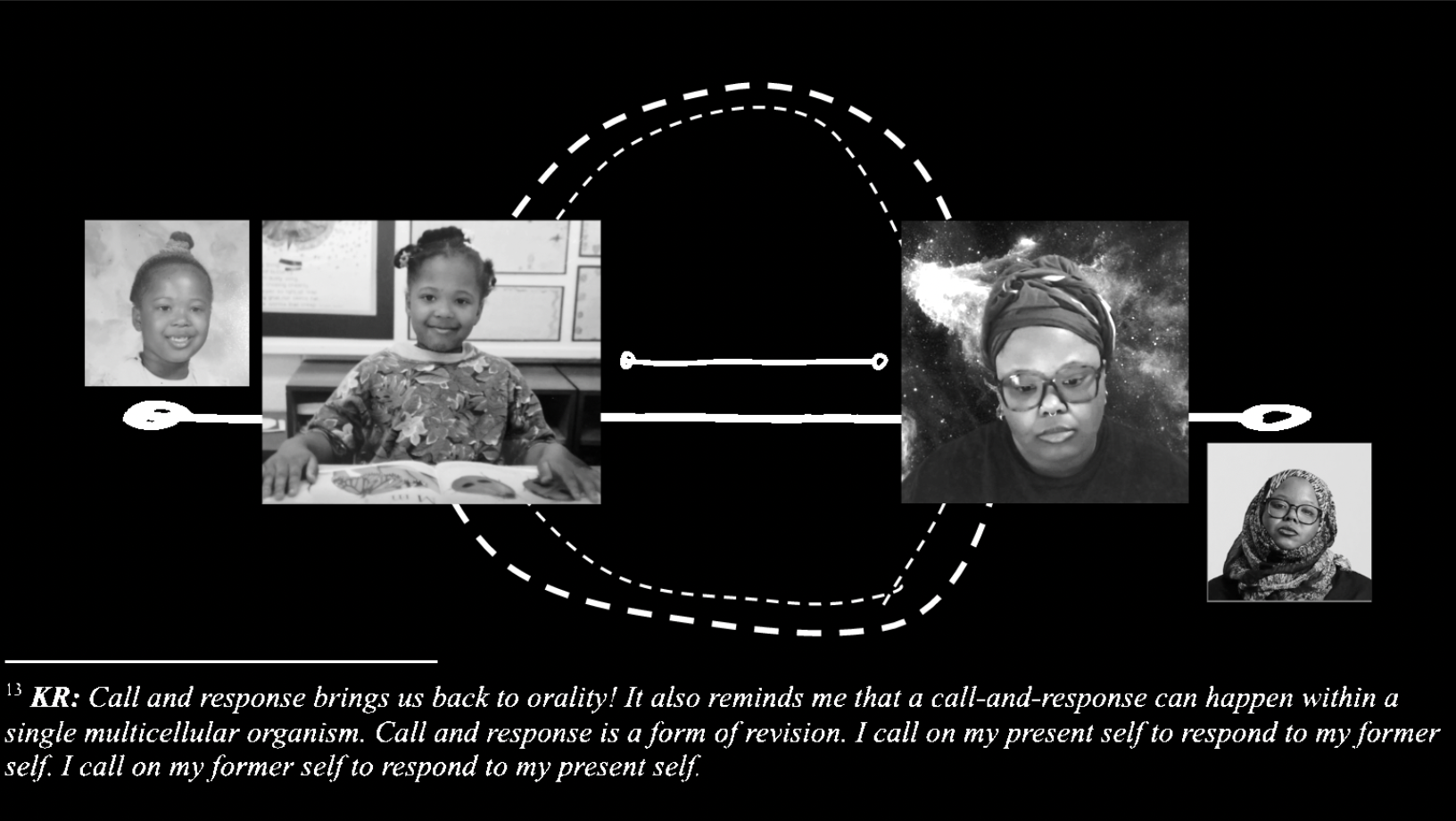
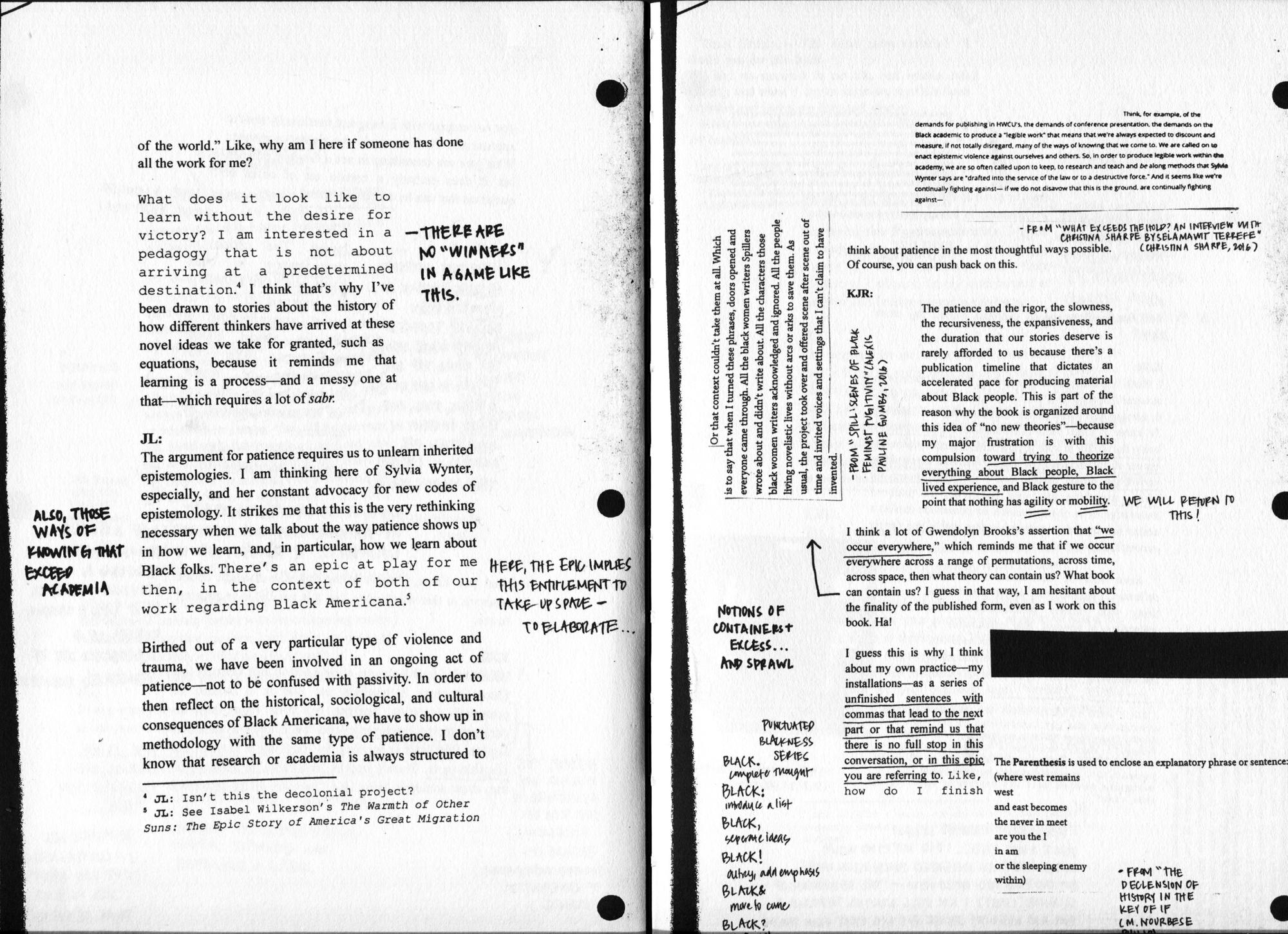
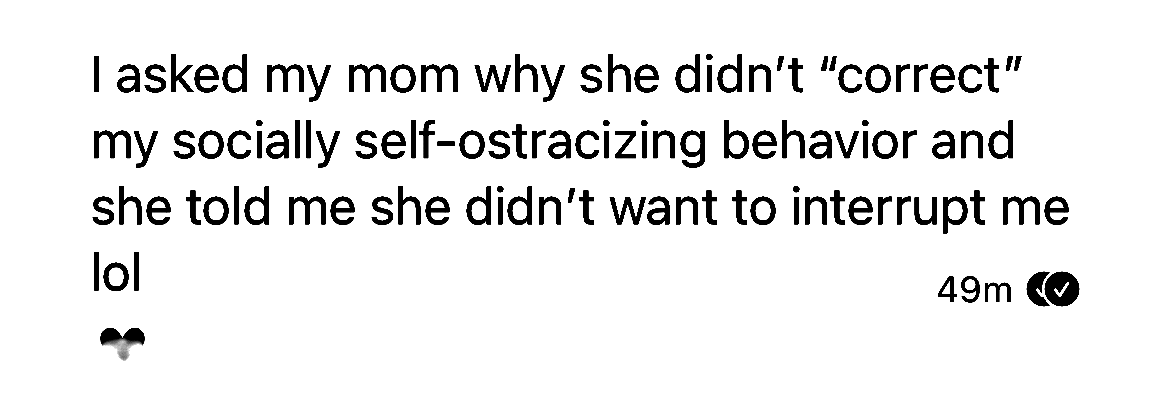
My first conscious encounter with disciplinary technologies
of noise suppression was in my high school English Literature
class.
My writing was always considered engorged and unruly.
I spent hours editing.
It was my jetsam - jettisoned words and syntax-
that I had to “throw overboard” to make it to the other side
of a well-structured essay.



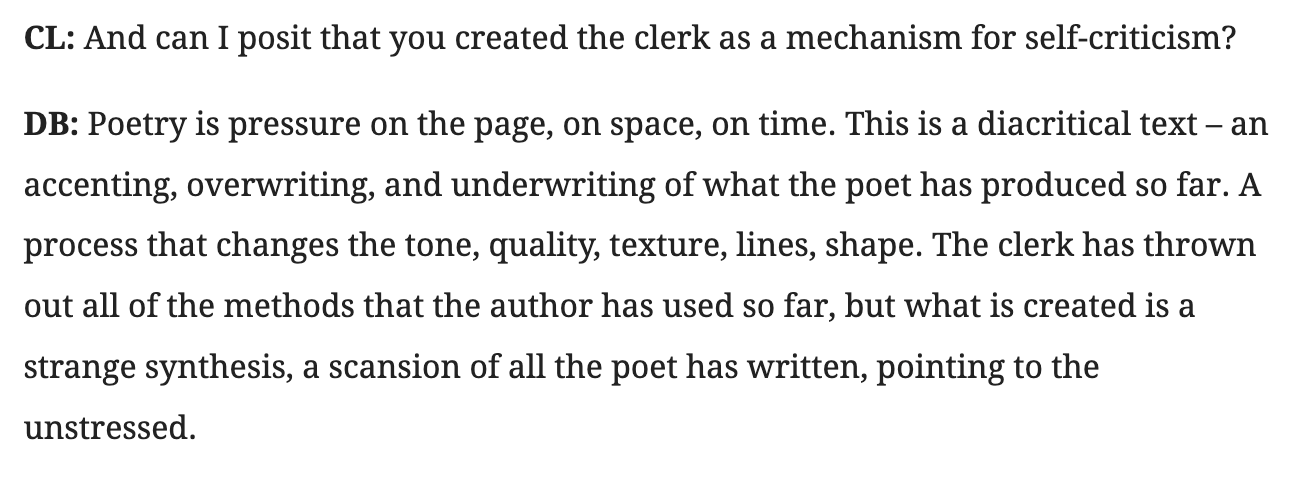
Q&A: Canisia Lubrin speaks to Dionne Brand about her two new books, The Blue Clerk and Theory (2018)
Thank you, Sarah Cervenak for excerpting this portion of the interview in her book Black Gathering: Art, Ecology, Ungiven Life (2021).
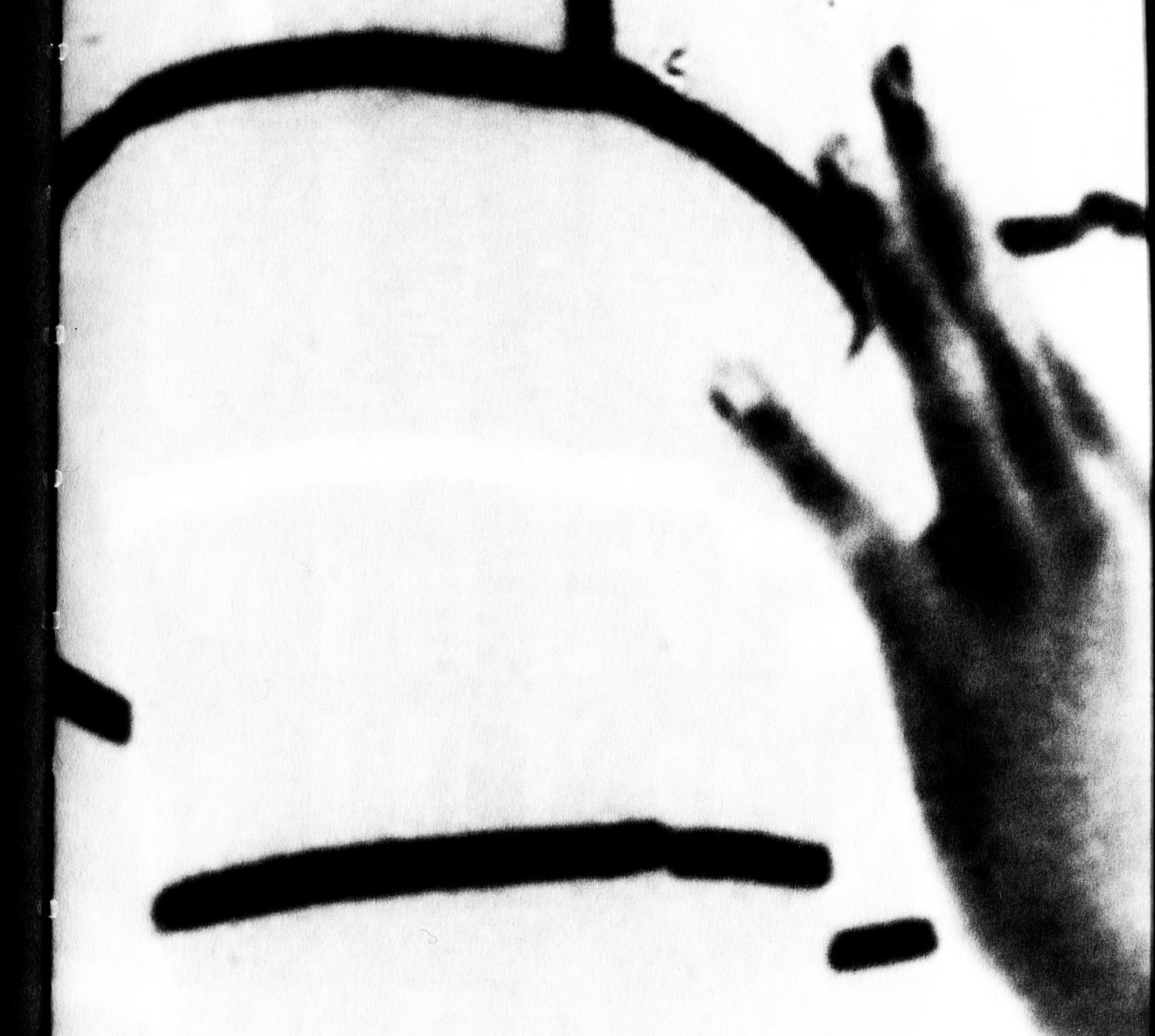

Lispector, Clarice. Água Viva.
United States: New Directions, 2012
Lately, I’ve been thinking a lot about reclaiming my
jetsam – like going and getting back what I left
behind, to see if, maybe, something is there.
I find myself thinking about the Adinkra symbol, sankofa.
Sankofa was introduced to me as a retrieval process –
“to return, go, fetch” or “it is not taboo to go back for
what is forgotten.”
That we go back and “fetch” what may have been there
all along, but not perceivable with whatever perceptive
program we have nurtured.
Our relationship to immediacy, efficiency, and use-value
often means that if something (and/or someone) does not
present obvious value, it is discarded or marginalized.
In this retrieval process, it is not about returning to get
something, but also about interrogating the perceptual
regime that rendered something unrecognizable as meaningful.
I am thinking about registers of attention.

(back to the top)


Lispector, Clarice. The Passion According to G.H. United States: University of Minnesota Press, 1988

Returning to one’s noise and attuning ourselves to the noise over there invites a divergent sort of perception:
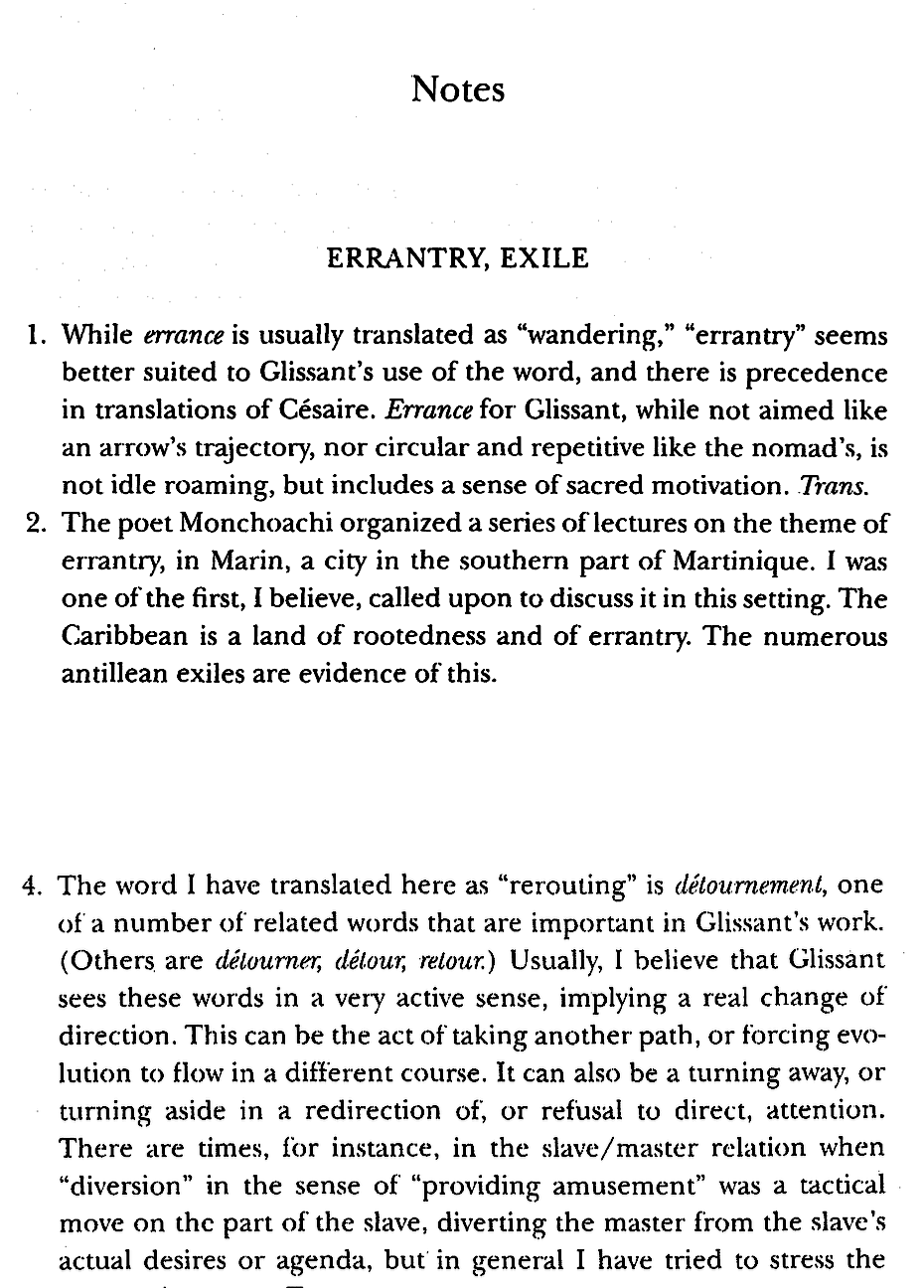
something errant,[O]
multisensory [P]
and expansive enough to “see” and “listen” for the frequencies we’ve been conditioned to treat as unimportant and the sensations that have been muted.
It is a political and spiritual attunement toward the silenced, disregarded, and pathologized.

What does it mean to pay attention?
How do power structures construct what is worthy of attention?
What are the consequences of these regimes of attention?
How is perception shaped by these regimes of attention?
How can we create alternative ethics of attention?
What is possible when we pay attention otherwise?
How do power structures construct what is worthy of attention?
What are the consequences of these regimes of attention?
How is perception shaped by these regimes of attention?
How can we create alternative ethics of attention?
What is possible when we pay attention otherwise?

On Infrasound
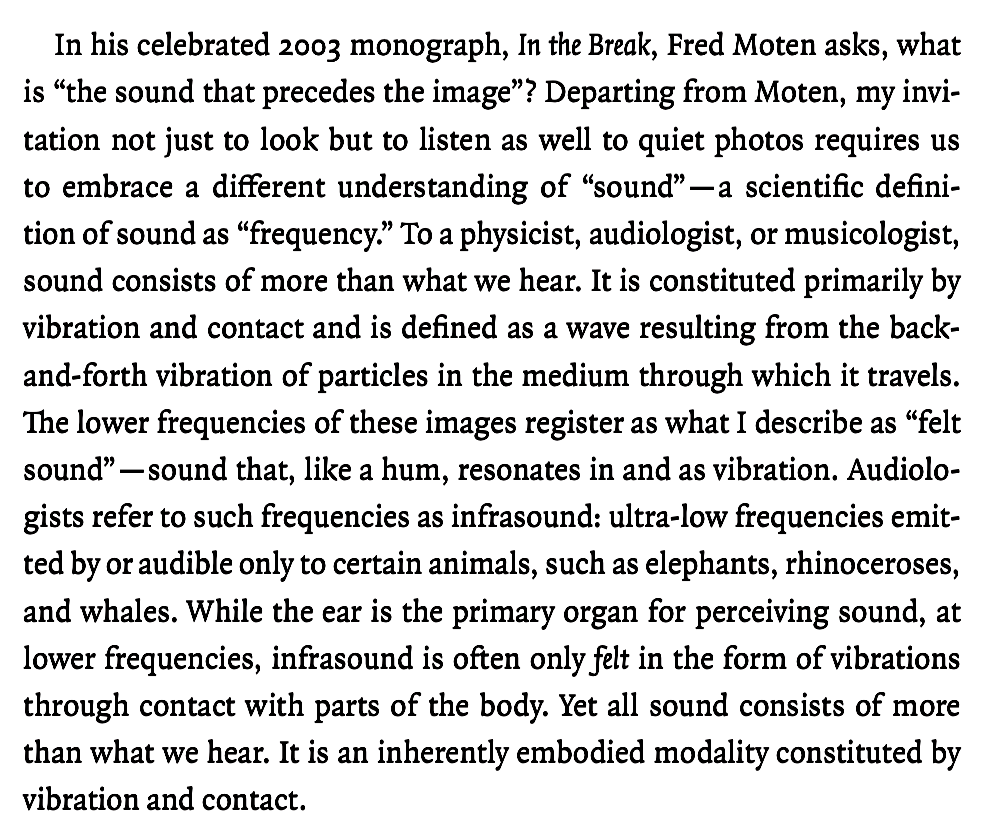

 Tina Campt reminds us that to look is also to feel.
And this excerpt seems to call back to earlier conversations
about noise - this assertion that there is more there (noise)
than what we acknowledge (signal).
Also, I have been thinking about
James C. Scott’s writing on infrapolitics.
Tina Campt reminds us that to look is also to feel.
And this excerpt seems to call back to earlier conversations
about noise - this assertion that there is more there (noise)
than what we acknowledge (signal).
Also, I have been thinking about
James C. Scott’s writing on infrapolitics.

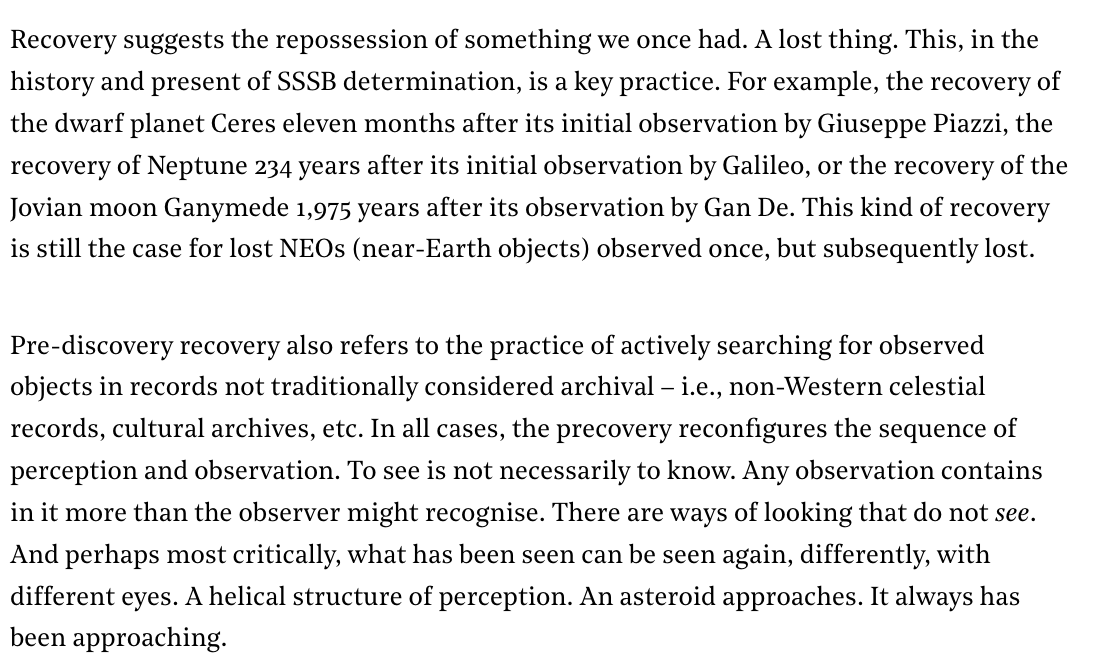
On Precovery

[...]
 BEEN (in my local Black vernacular): “BEEN”, or the habitual
be, has been linguistically theorized as an indicator of habitual
action and sometimes an indicator of someone's character.
Regionally and familially, we used the stressed form of BEEN
to indicate an intuitive, somatic, or ancestral fact that remained
unacknowledged until someone with power or status sanctioned it.
It is an implicit indictment of which forms of knowledge and
evidence are valued and a critique of how late everyone else
is to arrive at what seems like an obvious understanding.
For example, “we BEEN knew they weren't going to...”
We also used the “BEEN” to call someone out for pretending
they don't know something they actually know.
For example, “you BEEN knew she wasn't going to...”
This last usage reminds me of Toni Cade Bambara's essay,
“The Education of a Storyteller,” in her 1996 posthumously
published essay collection.
BEEN (in my local Black vernacular): “BEEN”, or the habitual
be, has been linguistically theorized as an indicator of habitual
action and sometimes an indicator of someone's character.
Regionally and familially, we used the stressed form of BEEN
to indicate an intuitive, somatic, or ancestral fact that remained
unacknowledged until someone with power or status sanctioned it.
It is an implicit indictment of which forms of knowledge and
evidence are valued and a critique of how late everyone else
is to arrive at what seems like an obvious understanding.
For example, “we BEEN knew they weren't going to...”
We also used the “BEEN” to call someone out for pretending
they don't know something they actually know.
For example, “you BEEN knew she wasn't going to...”
This last usage reminds me of Toni Cade Bambara's essay,
“The Education of a Storyteller,” in her 1996 posthumously
published essay collection.


On Defamiliarization, Unseating of Logic
 From
Warren Neidich's review of the 2024 Whitney ISP show,
Not Everything is Given
From
Warren Neidich's review of the 2024 Whitney ISP show,
Not Everything is Given

ostranenie! Counter-habituation!
I had the pleasure of reading a draft about my work, and the author used the term “defamiliarization” to describe it. Funnily enough, I’d forgotten about that word in relation to my practice, so it's been a fun experience to become reacquainted with a concept that speaks to the power of being unfamiliar.
Two things:
+ I’ve written the same question to myself over the past few years: How do you experience the world anew? Or, how can I encounter [fill in the blank] without the weight of previous associations?
When I was at UCROSS this summer, one of the resident authors shared their interest in aphasia. It prompted me to consider language “disorders” and how mispeaking and mispronouncing introduce newness. I had a speech disorder, and sometimes it sneaks back up on me. I wonder about words that do not feel familiar in my mouth and how my mouth regains familiarity with these strange words.
I am reminded of the introduction to Gabriel Garcia Marquez’s 100 Years of Solitude (1967)


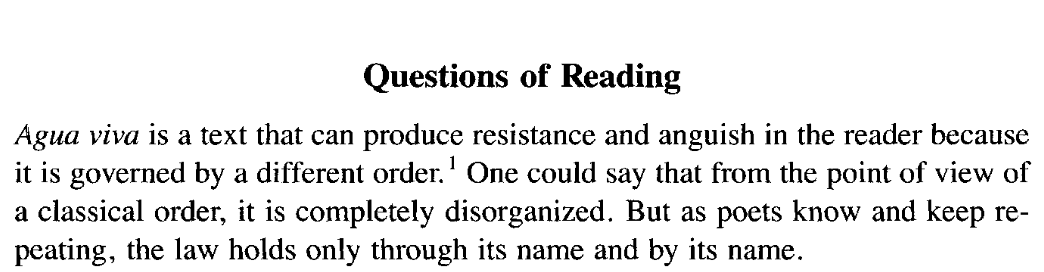
Of Possible Relations
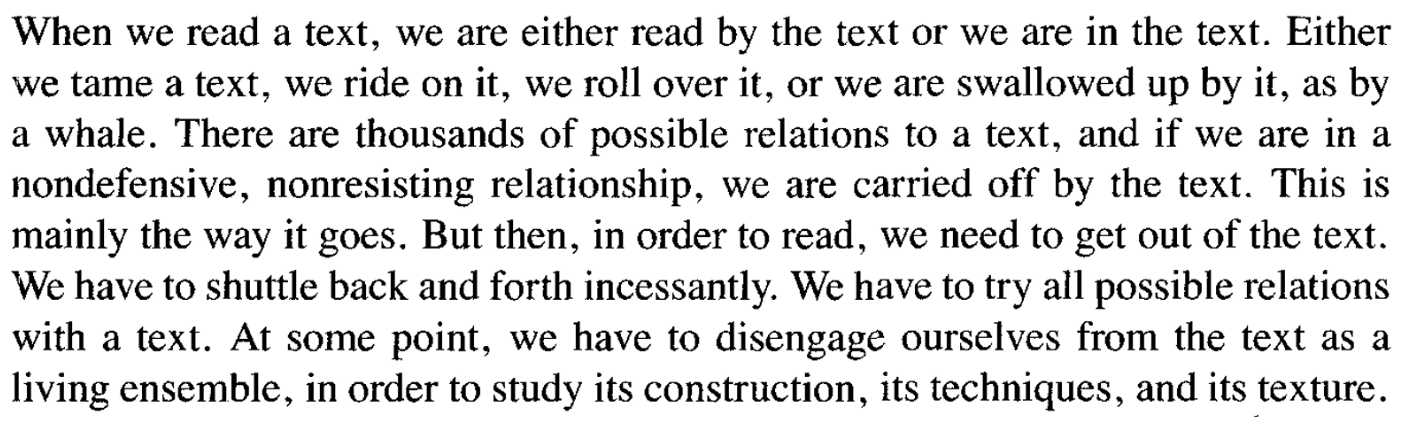


My engagement with noise, excess, and incoherence is a poetics
and politics of suspicion.
My work across KJR Studios sustains a healthy suspicion of plot,
rationality, and immediacy.
My practice considers what becomes possible through the
disobedience inherent in excess and noise: when matter
“misbehaves” (exotic matter and multiphase materials), when
words are non-compliant (non-traditional language practices),
when neurology does otherwise (my trinity of neurodivergence:
ADHD, OCD, and Autism), when bodies are “undisciplined”
(questions of “ugliness,” fatness, and physical disabilities)
and when beliefs exceed their imposed limits (the birth of new
spiritual movements, genres, and epistemologies).
I do not want to be quantified, reduced, made efficient, hemmed in, or translated into a data point.
I do not want to be quantified, reduced, made efficient, hemmed in, or translated into a data point.

I am committed to cultivating responsive and flexible systems
with distinct ethics: installations that refuse passive
spectatorship; learning environments rooted in collaboration
rather than competition; publications that remain perpetually
open to revision; archival structures that foreground
marginalized histories; and granting structures that celebrate
speculative and emerging ideas rather than rewarding only
established methodologies.